

EDITOR’S NOTE
By Andrew Tonkovich

Editor, OGQ

YOU ARE HERE (ALSO, YOU’VE ARRIVED)
2026 Writers Workshops Opening Talk
By Jason Roberts
It’s wonderful to see you all here, familiar faces and new. It’s a honor to be asked to kick this all off with a welcoming speech, and for that honor I have to thank Brett, who if you don’t know already is our Boss Lady Supreme, and Lisa, and Louis, and everyone who works hard to keep the community in Community of Writers.
One thing about an opening talk like this. I’m going first, but actually I’ll be last. By that, I mean: you’re about to have a very full week. If you work it right, you’ll be leaving here with a deep stack of memories. Memories of talented, insightful, intelligent–even brilliant–people. Talking. About writing.
Sometimes, they’ll even be talking about your writing.
If that makes you gulp a little, you’re in the right place.
My point is, what I’m saying now will probably be the last thing you remember–it’ll be at the bottom of that deep stack.
And that’s okay. What I’m about to say is for the week itself. And I kind of want it NOT to be remembered, but felt.
The name of my talk is: You are here. Also, you’ve arrived.
Where is here? Well, it’s a mountainside in California, elevation 6,896 feet. It’s a beautiful place, but its beauty isn’t what makes it important–at least, not for our purposes. What’s important is this: I don’t live here.
(pointing) You don’t live here. You don’t. You don’t. With the exception of a lucky few board members I see in the back, none of us live here.
Which means: we all set aside our lives. We all made arrangements. We all carved out a large chunk of time. And carving out time is very much a part of writing. Sometimes it’s the hardest part of all.
We carved out time, not to write so much as to consider our writing, which is also part of writing. Sometimes it’s the hardest part.
We carved out time to do this communally–this is, after all, the Community of Writers. We carved out this time just to meet here, on this mountainside. On common ground.
This is, in every sense of the word, a summit.
Our own Louis B. Jones calls attending these conferences “being at elevation,” and I love that phrase. I know just what he means. 6,896 feet isn’t Mount Everest. But it can divide your life into what you choose to bring, and what you leave behind.
A summit. Which means not only common ground, but equal ground. I hope you’ve noticed that the Community of Writers doesn’t have teachers, or a faculty. It has staff members, like me, and it has offerings. That’s not an empty egalitarian gesture. That’s by design. It’s an acknowledgement that we’re all humbled by the writing process, which George Orwell described as “a horrible, exhausting struggle, like a long bout of some painful illness.”
But it also sustains. As Margaret Atwood said, “a word after a word after a word is power.”
So yes. You are here. In the company of others trapped between horrible struggle, and power. Which is why I’d like to encourage you to think of this in another, perhaps more positive way. You have arrived.
* * *
What does it means to “have arrived” as a writer, an artist? That’s a curious condition, when you think about it. You never hear of someone “having arrived” as a welder or chiropractor, but you hear it all the time in our profession. When have you arrived, meaning roughly: when can you consider yourself to be a serious writer, a “real” one?
I used to think that the threshold was publication. A real writer was a published one. But that’s a very permeable barrier these days, when self-published books can become massive bestsellers, and at any event the footnotes of literary history are filled with people whose books fizzle, and fade. If you were knocking around New York City in 1956, you could have met a fellow named John, who had published one novel at the age of twenty-seven. If you did meet him, he would probably hit you up for some spare change, because since then he’d failed to find a publisher for his next book, and the one after that. And the one after that. He’d written, and failed to sell, eight more books.
So, no. Publishing is not arriving.
But he did finally manage to get that eighth manuscript printed. And on September 5th, 1957, John Kerouac–he had decided to start publishing under the name Jack–picked up the New York Times and read a review calling his book “an historic occasion,” that “has never been equalled in American fiction, either for insight, style, or technical virtuosity.”
It was the ravest of rave reviews. And it transformed his life. His publisher sent over a case of champagne. The author of the review called to say he was throwing a party in his honor. As his girlfriend at the time remembered, “Jack lay down obscure for the last time in his life. The ringing phone woke him the next morning, and he was famous.”
So, critical acclaim. That’s arriving, isn’t it? It certainly was for Jack Kerouac. But that kind of clarity, that clear-cut transition, is hard to find these days. I’m sorry to say, but publishers are no longer in the habit of sending over cases of champagne. Book reviewers are no longer in the habit of throwing parties for the authors they’ve just reviewed.
Newspapers are no longer in the habit of printing reviews, period.
I have one last example of the now-vanished importance, the generous importance, of book reviews. In October of 1952, the New York Times hired Eudora Welty, one of the greatest writers of the twentieth century, to write a review. Here’s what she wrote:
“What the book is about is friendship on earth, affection and protection, adventure and miracle, life and death, trust and treachery, pleasure and pain, and the passing of time. As a piece of work it is just about perfect, and just about magical in the way it is done.”
If you’re wondering if that praise put that book on the path to success, you’re right. The title in question is now one of the bestselling books of all time. But what was the title in question, this book of adventure and miracle, just about perfect and just about magical?
Any guesses?
It was Charlotte’s Web.
Newspapers are no longer in the habit of printing much in the way of reviews. They are certainly no longer in the habit of hiring giants of literature, like Eudora Welty, to review children’s books.
Don’t get me wrong. Critical acclaim is lovely and shining, and welcome fuel for the fires of your heart. Prizes are lovely and shining, too. It is a heady thing to win a Pulitzer Prize. But if winning some big-deal award is the indication of arrival, that would mean I “arrived” as a writer just last year. Which strikes me as silly. For a good number of years now, I’ve been telling people that I’m a writer. Not that I’m someone who’s trying to write.
The idea of that prompted me to think. When did I, personally, feel like I “arrived” as a writer? I realized the best way to approach that question was to rephrase it, in a more down-to-earth fashion. When did I start to feel, in my bones, that I was a “committed” writer? That I was all in, for what it was worth, and for wherever this path would take me?
The answer? It was here.
It was the first time I attended a week at the Community of Writers–when I joined the Community of Writers. Yes, I arrived as a staff member, but I had never before set foot in a writing class, or a workshop, or in any group of people talking about writing.
I had published one book. Any illusions that this might have qualified me disappeared with the first manuscript I was given to critique. It was from someone who had published two books.
I had every reason to conclude that an odd quirk of chance had allowed me to briefly pretend to be a writer, and that was it.
Here’s the thing about being at elevation–about the real and metaphorical mountaintop this week represents. It works both ways. 6,896 feet isn’t Mount Everest. But just as it can divide your life into what you choose to bring, and what you leave behind, you get to decide what you’ll bring down from the mountain. And I want to encourage you to leave here with what I brought down from the mountain. Not a sense of being a good writer–let’s keep notions of quality out of it. But the sense of being a writer. In the space between Orwell’s “long bout of painful illness” and Atwood’s “a word after a word after a word is power.” That’s where I belonged.
This–this here–is the modern rite of passage. This is what we’ve got. You’ve taken your work seriously enough to apply to the Community of Writers, and you’ve gotten in. You’ve found the time to step outside of your life. And–and this is more important than you know–you’ve found the courage to be here.
Welcome. You are here. And you’ve arrived.
* * *
I want you to give yourself permission to feel that. To feel that you’ve arrived as a writer, because if you came here anxiously looking for personal validation, that’s as close as you’re going to get. You came up here with works in progress, but you won’t get to harvest a basket of praise and traipse merrily home. You’re about to experience your work getting–well, not torn apart, but pulled, tested, contorted into shapes you don’t recognize. It’s very human to respond to this with dismay–don’t they get what I was trying to do? And then it’s also human to feel an even deeper dismay: they get what I was trying to do. They just don’t care.
You will hear comments that seem to undo any sense of progress in your work in progress. You will field suggestions that make you feel worthless, or angry, or both.
Remember what I said? You’ve arrived. I want the validation I’ve just given you to quiet those feelings. Wear it like an amulet around your neck.
Welcome all criticisms of your work. Even, or especially, the ones that seem so distant from your intentions they seem to suggest a manuscript from an alternative universe. They are not telling you how your story is wrong. They are demonstrating how the boundaries of your story are perhaps more permeable than you’ve assumed.
Michael Chabon says that he never loves his books more, than in that glorious moment before he begins to actually write them. That’s because the unwritten work is platonic in its perfection–every process of transferring the imagination to the page feels like battering it down, forcing it into sad limitations. Which sometimes feel like your limitations.
So take every critique as an alternative-universe exercise, as a refreshment–a returning, to some small extent, to the before times, when it was a radiant platonic ideal. Before you, of course, batter it down again. So, let’s say: someone in your workshop suggests of your characters: why don’t you make them all vampires?
Well, no. You don’t have to make them vampires. But since you’re no longer seeking validation, you’re free to pose an extending question, almost to play. What if they were sixteenth century peasants, in the French countryside?
What if they were sixteenth century peasants in the French countryside, pretending to be vampires?
Why would a sixteenth century peasant pretend to be a vampire?
Why would a sixteenth century peasant pretend to be anything?
What are my characters pretending to be?
And just like that, your possibilities are being battered into a whole new shape.
You no longer need to seek validation. Seek liberation instead.
* * *
This might be strange to say in an opening statement, but I’m really looking forward to saying goodbye to you. A week from now, your heads and hearts and notebooks full. Hopefully with that amulet of protection–of having arrived–still glowing on your chest. And with your own inventory to things to take down the hill with you, back to your own crucible. To your own space between Orwell’s pain and Atwood’s power.
Welcome to our summit, which is now your summit.
Welcome to elevation.
Thank you.

Jason Roberts is a writer of nonfiction and fiction. His most recent book, Every Living Thing, was honored with the 2025 Pulitzer Prize for biography, as well as the PEN America/E.O. Wilson Literary Science Writing award. His previous book, A Sense of the World, was a national bestseller, a finalist for the National Book Critics Circle Award, and longlisted for the international Guardian First Book Award. He serves on the Board of Directors of the Community of Writers, and lives in Oakland and Montreal.
A FIELD REPORT FROM THE LA POET LAUREATE, 2 MONTHS IN
By Brian Sonia-Wallace

At the end of April, 2026, I was announced as the new Poet Laureate of the City of Los Angeles, a role that was last occupied by Lynne Thompson but has been vacant for the past four years. In my application I made a to-do about being the first millenial to hold the title. Laureate is often a career capstone, but I’d held the role in West Hollywood and, building on that experience, pitched it as more of a community organizer role. They bit.
From the application: “My guiding vision is simple: a Poetry City, where every neighborhood has access to poetry as connective tissue…L.A. is full of poets! Why shouldn’t every coffee shop and bookstore have a poet-in-residence? There’s the possibility in this role to create a blueprint for that enduring ecosystem.”
I’ve always been invested in poetry in odd places — my big break came with a residency in a shopping mall that led to a NYT clip and a Harper Collins book deal. I was a theater kid before I was a poet, or simultaneous to it, perhaps, and so I’m always very audience-conscious. What will people sit through? Better, what will move them? I am impatient. I don’t want to wait until I’m dead to find out. I will endure the discomfort of sitting with people and seeing them respond, in real time, to work. For the past decade I’ve been a typewriter poet, scribing people’s best and worst selves at weddings, bat mitzvahs, and last month at Taco Bell’s Corporate Marketing Retreat. Live Más. Poetry!
Now I’m two months in to the Poet Laureate role, and really what it’s doing is further expanding my mind to the places where poetry can live. From opening with a mission to talk to Metro about doing poems on trains and buses, I’ve quickly expanded to wanting to talk to every city department, almost as a challenge to myself, Poetry’s Ultimate Salesman, to see who I could get to sign on. The zoo was easy, the president and her husband used to geek out over Def Poetry Jam. The airport, likewise. They have their own in-house art department with a mandate for customer experience. I’m smug about all of this, by the way, but the thing I’m most smug about is the LAPD. I asked myself: What department is least likely to gravitate toward poetry or feel a natural affinity toward it? These are the alliances I want to build. Who, if the position is vacant again for four years, can come knocking and get it filled? The police, that’s who.
Metaphor is discovering the ven diagram overlap between two unlike things, so it’s no surprise as a poet that this matchmaking between unlikely bedfellows is the kind of puzzle I love most. In puzzling what poetry project might interest the police, it came to me: Isn’t poetry so much honoring of the dead? And which city department is most concerned with honoring their dead?
I learned from my West Hollywood Laureateship that anything in government takes at least 6 months with all the approvals you have to get, so my opening salvo has been aimed at introductions. I’ve been lucky — the Laureateship is housed in the Library, but in partnership with the Department of Cultural Affairs, and both those departments are overseen at the Mayor’s Office by a Deputy Mayor who I’ve become chummy with, and can ask things of, like, for instance, “Would you introduce me to animal control? I have an idea that high school students could write poems for pets who are up for adoption, to feature on the website.”
This is the crux — I don’t believe poetry “makes nothing happen,” screw you, Auden, I think we turn to poetry, in our hour of need, and a poet can see that turning, if they’re looking, and reach out a hand. We are so isolated and AI-addlepated and men are in crisis yada yada. Pets need adopting, and we (poets) have the tool of personification. The dead need elegies, and that’s our jam. People at the airport need to hate their lives a little less. The zoo needs to create wonder.
There’s a personal work happening here, too. When I started, all of the Spanish-speaking librarians at Central started talking to me in Spanish. Could I really do Spanish-language programming? In a way, they were testing me. But there was also the offer of kinship in it, of shared thought and work. They were offering me (who grew up partly in Chile, but then did his best as a teen to forget the language), an invitation through the laureateship to reclaim that part of my own history. To write and speak and teach in Spanish not because I’m perfect at it, but because I’m adequate, because it will allow me to speak to more people.
I’ve always loved LA, it’s complex hybridity of cultures. There are so many LA’s. We are as big as many countries, and have communities from so many countries making up our fabric. Los Angeles is full of people carrying names for mountains that aren’t here, orange groves that are gone, languages that survived the crossing, languages that didn’t. The city is constantly being renamed by the people who arrive. Our work, as writers, is to create the conditions for that naming to happen consciously.
Everyone and no one is a stranger in LA. I love that I grew up here and have lived here most of my life and still discover new longstanding cultural institutions every month (there’s a Portuguese bullfighting ring in Artesia?!). You can never “finish” LA.
Plus, as a poet, it’s important to have mountains. It’s important to have the ocean handy, for emergencies. It would be nice to have affordability. This is a hard city. There’s no getting around that. But it’s also a place of limitless potential for creativity. There’s nothing like being in community with creative people. And this is where they come. This is where they are made — this city is a kind of permission. However weird your niche, you will find your people here.
But I became Poet Laureate as my city was stitching itself back together, feeling the wounds of the fires and ICE raids. There is a story of resilience, of being besieged, and of recovering while still undergoing harm. We live, nationally, it is I think generally agreed, in the shit. Things are devastating, and we’re mad about it. In such a context, the argument of my life, perhaps, goes, we need whimsy now more than ever — frolicking as a political act.
I think of the surrealists in the wake of the first World War. In the face of atrocity, only the absurd makes sense. In fact, only the absurd can help us make sense of a world whose logic has become prematurely metaphor. As even basic services are cut, local municipalities scramble for their budgets and the arts are always the first things on everyone’s chopping block. But fascism is an aesthetic movement, and I believe strongly that part of what is required is an aesthetic response.
Luis Valdez, founder of the Teatro Campesino, who has made art with farm workers in service of their political movement since the 1960’s, says, “Arts are how we express existence. To uplift arts is to uplift existence.” On a metaphysical level, this is the goal.
On a practical level, what I’m interested in doing with poetry is sort of a stunt. But do you know why everyone knows who Alan Ginsberg is and, unless you’re a Beat scholar, you might not be able to name another Beat poet? Because his day job was as a publicist, and he knew how to throw a party and how to cause a scandal. I am done with scandalous politicians. The time for scandalous poets is now!
So. I’m going to see if the 72 neighborhood branches of the LA Library want to start writer-in-residency programs with me. After all, I got my big break because a mall told people I was its writer-in-residence, and it gave me the courage to believe it, a little bit.
68 people applied for the Poet Laureateship, applied to be the next Voice of the City, or whatever. The “or whatever” feels like the real power here. This role, hard numbers, is a small $10K grant that requires 6 readings and 6 workshops, but that number is kind of arbitrary — as I’ve met with the Library and Cultural Affairs and the Mayor’s Office, the question has been the same: What do you want to do? How often in life, especially as an artist, are we asked this question? How often do we get this awesome, terrifying freedom?
To dream, with a key in one hand.
My term is a year. Renewable, but it’s too soon to ask about that. So I’m starting 100 things now, knowing City processes will do their best to stretch them out into forever. Already the City Attorney’s office scuttled my plans for a youth poetry competition around the World Cup over parental permission requirements, the rules sheet is now 15 pages and the games are already ending — we’ll retool it for back-to-school. Metro has told me we can talk in August, they’re too busy until then.
As I commit to doing more, I am taking as my mantra, “Anything worth doing is worth doing poorly.” If it wouldn’t be done otherwise, and you can do it, even if it’s just a beginning, a sketch — we have an obligation to show that it is possible. I think of Mamdani and the five government-run at-cost grocery stores in New York. Five grocery stores isn’t going to put Walmart out of business or affordably feed all of New York. But it is a model, this is possible, a statement of values, this is what we are capable of doing, together.
This weekend, 10,000 people came to the LA Central Library to celebrate its Centennial — “A Century of Light” as the title. In my opening poem for the festivities, I said, “This is the final thing which is not for sale.” I’ll leave you with these lines from that poem, with manifesto intentions:
no metropolis can be home
which has no home for knowledge…
It’s America. Surely, no one reads anymore.
But dig down. There is a country under this country
that has been burnt, but is still growing,
a common good we are bold enough to believe in
through the ash cloud of history…
our crescent eyes, like new moons, lift
to see that torch still singing out, Los Angeles!
Each year another burnt orange symphony,
call us science fiction, we know
what we are building toward —
I think we’re going to be able to do big things. My email is rentpoet@gmail.com. Reach out if you have ideas. I don’t plan to sleep this year.
Brian Sonia-Wallace is the Poet Laureate of Los Angeles and the author of The Poetry of Strangers (Harper Collins). They are the former Poet Laureate of West Hollywood, an Academy of American Poets Fellow, and the Poet-in-Residence for both Amtrak and the Mall of America. Brian has written over 10,000 poems for strangers across the world on a manual typewriter. He teaches at UCLA Extension and leads school outreach for Get Lit – Words Ignite.
THE FUNNY POET
by Charles Harper Webb
Just as a seven-foot-tall CPA might well be called “the tall accountant” despite his many other qualities, I’ve been “the funny poet” for as long as I’ve been publishing. On finishing a book of mine, readers have expressed surprise that so many of my poems are “serious.” By this, they usually mean sad, or even grim. But seriousness can coexist with humor in a poem. Even my saddest and grimmest may include a hint of levity, a touch of fun.
My two poems included here use humor in different ways. “Chauffeur” is serious in its tenderness toward its young lovers, and seriously intends to memorialize their rapture before time steals it away. The extravagant imagery, though, seems humorous to me, reflecting the self-centered and dramatic high seriousness of young love. The couple themselves are funny, laughing at the adult world which they think has no idea what they feel.
“Department of Discontent” is more overtly humorous, though also sad and even bitter in its sending up of government. The informality of prose poetry undercuts the presumed high seriousness of the Department’s work. The official’s ridiculous answers to the petitioner’s reasonable questions are meant to provoke a smile as well as a hiss. Bureaucratic idiocy has far too much sway in American life; but humor helps to keep it from swallowing us whole.
I’m hardly the first person to note that the best comedy rises out of underlying tragedy. Yet tragedy is not devoid of humor, even if the humor consists mainly in watching people try to evade mortality. Humor is one way we can cope with “the heart-ache, and the thousand natural shocks that flesh is heir to,” in the words of one whose humor has outlasted 400 years. Humor, I tell my students, makes us laugh even as it brings us the bad news.
Of all the questions I’ve been asked after poetry readings, the most frequent is, “How can I learn to write funny poems?” The starting point, I believe, is to see the world in funny ways. Don’t be quick to dismiss your own wilder notions as worthless, or that ultimate humor-killing put-down, immature. Wacky ideas, taken seriously, can lead to creative breakthroughs. On the other hand, things which the Powers-That-Be hold up as sacrosanct may cry out for poetic ridicule. This realization can be liberating and fun, which is why the Powers fear humor.
I want my poems to be a pleasure to read, and I know that humor helps. But I don’t set out to write funny poems. I set out to write true ones. Humor is not a spice I sprinkle on to improve the taste. Humor infuses my work because it’s fundamental to the way I see the world. I tell students that their goal should be to discover their own unique vision, then capture it in language as perfectly as they can. This will lead them to their “style,” their ‘voice,” whether humorous or not. When craft is sufficient to convey fully a poet’s unique vision, the poet has succeeded. What others think of the result is out of the poet’s hands.
Humor in poetry often gets, to quote Rodney Dangerfield, “no respect” from the dolers-out of honors and awards. Keats’ letters are full of humor, but he mostly kept it out of his poems. Byron, “mad, bad, and dangerous to know,” is a different story—one from which I’ve learned a lot. For me to write without humor would be like forcing a four-cylinder engine to run on two: a guaranteed bad ride. I welcome humor into my poems, even at the risk of not getting a MacArthur or Nobel.
Oh well. People who write poems in the hope of fame and fortune deserve what they’ll almost certainly get. The one good reason to write poetry, as far as I can tell, is because you love good poems, and want to create more of them. The next time you sit down to write, if humor knocks, see what happens if you let it in.
CHAUFFEUR
How comfortably they lean into each other
in my car’s back seat—the boy I taught
to hit a curve and play guitar, embraced
by the blonde girl from Hungary. They know
things they’re certain no one else can know.
Having become, as the Bible says, one flesh,
they see even those whose love created them
as stowaways to be booted off their ship.
They laugh to see us growing smaller
as hot winds shove their sails toward isles
of orchids and spice, azure lagoons that teem
with fish painted in crimsons, emeralds,
tangerines no eyes but theirs fully perceive.
They’ve heard from us how quickly calm seas
can summon waves to smash them,
winds to tear their sails and hurl them
onto shores where sun can’t pierce
the hail of pumice and brimstone. But
they know adults are full of baseless
fears. My son, I see as I change lanes,
has placed his head in the girl’s lap.
He shuts his eyes. She shuts hers too,
stroking his hair, then folds over him
like a flower closing for the night.
From Old Gnu, Longleaf Press, 2026. First published in Southern Poetry Review
DEPARTMENT OF DISCONTENT
The officer in charge checks my ID, and asks, “Formal or informal complaint?”
When I hesitate, she says, “Informal’s more relaxed. You speak more softly, don’t raise your blood pressure, can wear jeans, no tie, use contractions and slang. Very chill, as the kids say. With formal complaints, you have to shout. Formal complainants sometimes die of strokes. Also, you need to wear a tux.”
“Which one works better?”
“That’s confidential. Either way, we interview everyone in your complaint, then everyone in those interviews, everyone in those, etcetera. Leave no tern un-stoned, as the joke goes.”
“When will I know the results?”
“You won’t. They’re confidential, too.”
“How does that help me?”
“Well,” she observes, “you already look younger than your I.D. Less beaten-down.”
“I did get energized, thinking I’d stand up for myself.”
“And so you have. Complainants sleep better, having taken steps. They walk taller for having had their say. Never doubt that, out there in the Dark Beyond, Justice sends a big, wet kiss your way.”
From The Elephant of Surprise, Moon Tide Press, 2026. First published in Vox Populi
Called by Lifescape “Southern California’s most inventive and accessible poet,” Charles Harper Webb has published 14 books of poetry with University of Wisconsin Press, BOA, University of Pittsburgh Press, and most recently, Old Gnu with Longleaf Press, and The Elephant of Surprise (prose poems) with Moon Tide. His book of craft essays, A Million MFAs Are Not Enough, was published by Red Hen Press, which also published his novel Ursula Lake. Webb’s awards in poetry include the Morse Prize, the Kate Tufts Discovery Award, the Felix Pollock Prize, the Benjamin Saltman Prize, and the Editor’s Choice Award from Longleaf Press. His poems have appeared in many distinguished journals and anthologies, including American Poetry Review, Paris Review, Iowa Review, Yale Review, Harvard Review, Poetry, Ploughshares, Tin House, Poets of the New Century, Best American Poetry, and The Pushcart Prize. A former professional rock musician and psychotherapist, he is the editor of Stand Up Poetry: An Expanded Anthology, and recipient of a Whiting Writer’s Award, and a fellowship from the Guggenheim foundation. He is Professor emeritus of English at California State University, Long Beach.
MODERN LOVE: WAS I A TERRIBLE DAUGHTER, OR JUST AN HONEST ONE?
I needed distance to write honestly about my childhood. But fiction didn’t protect any of us from pain.
by Dylan Landis
Thank you to the New York Times for permission to reprint this piece.
 For three days in 2002, my mother secluded herself in our guest room in Santa Monica, furious and depressed over my second published short story. I had known she would see my work as a cruel funhouse mirror, so when my story ran in the Santa Monica Review, I stashed my four copies on a high shelf.
Conspicuously identical, they had caught her eye.
The mother in the story, Helen, starved herself of food and starved her teenage daughter, Leah, of affection. A child of Holocaust survivors, Helen was a “wire” mother who raised a nervous girl drawn to science and the safety of facts.
Whereas my mother embraced and kissed me. She taught me to read, curated novels for me as I grew and raised a writer who produced — as I pointed out when my first published story distressed her — fiction.
Still, there lay in my work an encoded truth about how she had mothered me when I was young. She called herself a “psychoanalyst by marriage,” given my father’s profession, so I knew she would perceive that truth in Helen’s relationship with Leah.
Until I was 12, my mother slipped repeatedly from her adoring and caretaking self into depressive states so deep they turned her stony, cold, verbally nonresponsive. This robotic mother made dinner and ironed my father’s shirts, but if she loved me, or even quite knew me, I couldn’t tell.
It terrified me.
In that state of fear, I, too, went numb. Burned into my memory is the image of a girl and her mother silently reflecting each other across a tiny, dark apartment — the parent in her distress looking vacantly away, the daughter in dread, watching carefully from the white of her eye.
Always, I felt enormous relief when she returned to her loving self, reading to me, stroking my cheek.
That time in Santa Monica, I tiptoed past the guest room door and watched my father bring her meals on a tray. “Dyl,” he said, “she’s angry about how you portrayed Helen.”
I had a hundred questions and asked none. Was she having a flashback? Did she hate me? Did my writing make me a terrible daughter? My father didn’t say. I loved my mother madly; I wanted her back.
I hadn’t seen her like this in decades. At 46, I felt 4 again, in the grip of that ancient fear that my mother might wash her hands of me. For three days I felt paralyzed, afraid to knock on her door.
At the same time, I wanted to barge in and defend myself. It’s a short story, I would have said. Sometimes a cigar is just a cigar!
When she finally emerged, my mother was civil. She didn’t speak about Helen — and my father and I didn’t press her, any more than we had in my childhood. We had acted then like she’d been fine during her depressive spells. She mutely served meals as if they were clay, and my father, still just in grad school for his psychology Ph.D., gamely tried to break the spell with cheerful conversation.
Perhaps it was his inexperience as a psychoanalyst-in-training, but I don’t remember him ever confirming for me that something was wrong with my mother. He would have been devastated to think that his upbeat behavior left me feeling frightened and very alone.
Now I understand that my mother had flashbacks around that time from her own brutal childhood. They spilled over into the horrific stories she sometimes told when she tucked me in — of the medical experiments performed in the Nazi camps, or of how her own mother relentlessly beat her for years.
I remember how her careful detail overwhelmed me, how it kept me voiceless. Memories of childhood violence must have swamped her; why else would she unburden herself to a child?
And all these years later in Santa Monica, she must have felt the slap of judgment in my innocent — or not so innocent — short story.
Five years after the guest room crisis, my mother was helping me tie cushions to my patio chaise longues when she abruptly stopped and stared off with a hard expression.
“You have no idea how difficult it was for me back then,” she said.
I looked at her in alarm; we had been talking about staging my house for sale.
“When you were born on Avenue B, I carried the groceries, the baby carriage, and the laundry up and down six flights of stairs. No one helped me. You weren’t fair to Helen at all.”
She had been chewing on that for five years. I wanted to shout: Helen is fictional — are you still on that?
In her criticism, I heard only rebuke, not the underlying hurt, and fumbled a defensive response that I still regret. She had tried to open a dialogue. It was I who couldn’t face her anger. Now I wish I’d said, “You’re right. My stories do fail to tell Helen’s truth: the weight of your despair, how angry and unseen you must have felt.”
What an act of love that would have been. If I had managed that, I might have added, “Can we also discuss the emotional truth the stories do tell?”
But it never happened. Her closed door still frightened me. I did once ask if she’d had therapy as a young mother, and she said we’d had no money for it. She consulted a psychiatrist, though, who offered Elavil. It put her to sleep, and she threw it out. Psychiatry in the early 1960s had little to offer a woman like her — brilliant, literary, wilting in the home while her husband bloomed in grad school.
Philip Roth once told a young Ian McEwan, “You have to write as though your parents are dead.” Blunt, even cruel advice, yes. But as I hear it, he wasn’t preaching contempt. He was speaking to honoring one’s separateness and private truth as an artist, even if it causes pain for those we love. Then, one hopes, we work to negotiate that pain.
And perhaps it’s good counsel for anyone trying to navigate their own truthful path — struggling to come out to a conservative family or explaining to parents bent on rearing a doctor that one yearns to be an arborist. At any rate, I kept on writing like that long after my mother emerged from the guest room.
So it might seem logical that I would start hiding all my published work, sparing my mother’s feelings, and purchasing my literary freedom.
But my parents would have known. They had Google alerts! My mother, a great reader, was fiercely proud of having a writer for a daughter. Had I hidden my successes, even with a loving explanation, she and my father would have felt just as injured.
It was a weight I chose to negotiate. When they came to readings, I curated selections for minimal emotional damage. And I relished my parents’ pride when my first story collection came out in 2009. Still, they both delved into the stories as if analyzing my dreams, and I deflected their questions, craving privacy.
“Fiction is not a mirror,” I protested at one point.
My father, his arm around my mother on their sofa, laughed and said, “Yes, it is.”
If I’d had gentler material in my head, I would have written it. Yet family themes still obsessed me as I made notes for a novel. Fiction writing remains the only language I have found to express and expunge that dreamlike dread I remember from childhood.
I was still writing as if my parents were dead when their health lurched toward failure. I spent five panicky years in a state of devotion. In my family, one did not “visit” the hospital, one moved in, and so I often found myself writing on a narrow banquette in my father’s hospital room by day, then heading to my mother’s hospital room to sleep.
Each time they recovered, they asked about my work, but, weakened, settled for elided answers: “It’s going great, thanks!”
I missed my vigorous parents. But they gave me an unexpected and liberating gift, because the second manuscript was even more radioactive than the first.
When the hardcover came out in 2014, both parents were in wheelchairs, unable to focus on printed matter and grieving the loss of reading.
I recall my mother receiving the novel on her lap as if I’d handed her a kitten, the tenderness of her touch as she weighed it in her delicate hands. She stroked the pink and orange cover, then held it up for my father to admire.
“Oh, darling,” she said, and her tone filled my heart, because here was the loving mother whose constancy I had craved as a child, and now finally had. “What a beautiful book.”
Dylan Landis is the author of three works of fiction in the Rainey Royal Cycle set in 1970s Greenwich Village: List of All Possible Desires, a novel in stories; the novel Rainey Royal, a New York Times Editors’ Choice; and the novel in stories Normal People Don’t Live Like This. Her work has appeared in The O. Henry Prize Stories and The Best American Nonrequired Reading, and she has received a National Endowment for the Arts fellowship in fiction. She lives in Los Angeles. dylanlandis.com [F]
“MERMAID HAIR” FROM LABOR: ONE WOMAN’S WORK
by Mary Fariba Afsari
Three of my medical assistants sit me down at the end of the day. We are in our break room surrounded by bulletin boards covered with photos from our most recent office party.
“So, we’ll put half of your hair up out of the way and just work on the back half, right?” Alycia is in charge of the operation. She’s lost seventy pounds over the past six months through a diet of fasting, candy, and tequila after learning her husband has another wife and family in Guatemala. This left her mascara-stained on certain days and near asleep on others. I scold her when she is down and rejoice when she is back up. She provides me with a secret drawer of Jelly Bellies, gummy bears, and strawberry bubble gum that I sneak in between patient visits.
“Right. Aqua streaks. Pops of fuchsia.” I lean back in the chair. “I trust you.”
The other two women bounce around the room with phones in hand. They are taking photos, posting on Snapchat and Facebook. I imagine the caption: “Giving our doctor mermaid hair!!”
A few days earlier I spent an especially pernicious bout of insomnia scrolling through pictures of women with hair dyed various shades of hot pink, turquoise, and purple. My long, brown hair has recently grown out a light-colored balayage and the ends are turning blond in the summer light. Perhaps color might ignite a spark of magic into my forty-something, doctor-mom life.
It takes about twenty minutes. The team fastens a paper sheet—the kind we use to cover naked laps during pelvic exams—across my chest. Alycia is a self-proclaimed amateur hair-and-makeup artist. She knew exactly which tubes of dye to purchase when she ran to Sally Beauty Supply over her lunch break, and now she pins up the front sections of my hair with authority. As she applies color to the long strips of hair falling around my shoulders, drips of pink and turquoise and a purplish blend of both stain the front of the paper sheet. I surrender all control. I am usually the one in charge, and right now it feels good to hand it over to her. After the color is in, the group takes a final photo. I stare at the image on the phone screen. I look like a cartoon-character version of myself, with half my hair pulled up in front and a rainbow of hair, wet and pungent, splayed across my chest.
I try to smile. This picture captures my internal midlife chaos in one unfiltered shot.
“Go straight home, Doctor A.” Alycia laughs. “Hope you don’t get called to the emergency room!”
The other two chime in with instructions—wait forty-five minutes, then rinse off in the shower. Use deep conditioner.
“It’s gonna look great!” they call after me as I head out the door. I hear their laughter behind me and head to my car. It is well past six o’clock. I am hungry and tired and unable to stop at a grocery store looking like this. I get into the driver’s seat and glance in the rearview mirror.
I look like a crazy person, I think. The summer has been one of growing anxiety. New strands of gray at my temples brought with them so many uncertainties and intimations of regret. I question my decision to become a doctor every day. Lately, I even consider leaving my career. This brings late-night panic attacks and long talks with my husband, closest friends, and not one but two therapists. For about a year now, unbeknownst to most, I have been in crisis.
“Mermaid hair.” I angle the rearview mirror to point at my colored streaks. Like so many of my spontaneous ideas, it now feels frivolous and ridiculous. I wonder how quickly I can get home to wash it out before it sets.
The drive between the office and my home is the equivalent of a cleansing bath. With my days spent in total engagement with patient after patient, and the nature of my job one of unpredictable needs and heightened emotion, I relish the solitude of my twenty-minute drive home.
I turn out of the parking lot and the smell from the hair dye is profound—an attempt at floral essence to hide the strong chemical undertones. I know I am frying the bottom half of my hair with every passing minute, but fried hair is low on my list of concerns. Hair can be cut and reinvigorated in an instant. That is nothing compared to the invasive surgery I am scheduled to perform tomorrow. Or the disappointment my daughter feels when I miss her summer camp performance to deliver a baby. Or the diminishing returns my husband is certain to be feeling in our decade-plus-long marriage, where energy pours out of me all day and I require quiet and replenishment every night.
Yes, I could chop off the ends of my hair and there would be a momentary regret because, yes, I had spent the past year growing it to this long, sexy-in-her-forties length. But I know, from Deepak and Oprah and Eckhart, that everything is temporary, including the stuff that does not really matter—and also the stuff that matters most.
I am only two miles and a few minutes from the office when traffic slows ahead. I press on the brakes and roll down the windows to clear the air of dye. This slowdown is a little unusual. I creep the car forward, looking at stopped traffic on both sides. It only takes a few seconds for me to discover the reason. In the opposite lane, the side of oncoming traffic, I see a motorcycle lying sideways on the road, and next to it, the body of a woman. A quick glance around confirms—no ambulance, no fire truck, no police car. The accident just happened, and aside from a couple of bystanders hovering over the body, there are no first responders on the scene.
It is a moment doctors talk about: the instant, on the freeway, or on an airplane, when an emergency occurs and Good Samaritan laws kick in. When the request is made for a doctor to “ring their call light.” A good friend of mine who is a seasoned anesthesiologist says in those moments he asks himself, “Am I a doctor? Because nobody will know if you decide you’re not.” I always laugh when he says this because the question of whether I am a doctor never crosses my mind in an emergency. Every other minute of the day I question my doctor-ness, but in dire situations—such as a body on the road—there is no question. Right now, I see a woman on the road and nobody around to help. I am also dressed like a person who believes she is a superhero, complete with paper cape and colored, dripping hair. I am not going to make it home for the forty-five-minute rinse and conditioner.
I stop the car and make the snap decision to rip off the paper sheet. I allow the color to simply drip, and I am aware of the matching bright-colored stains on the front of my shirt. A bystander has a 911 operator on speakerphone when I approach.
“I’m a doctor,” I say quickly. “Do you know what happened?”
I speak while I move, and I move quickly. The mind-to-body connection of most physicians is quick. We can talk and move and think faster when necessary. We can observe what is right in front of us, take in our surroundings, and process multiple conversations at once. I do not know this about myself in a conscious way, only in retrospect. Thinking back to those first few minutes on the accident scene, I am acutely aware of the row of teenagers and young children on one side of the road—family members of the opposing driver. I clearly see the body-sized indent in the passenger side of the vehicle that was turning onto a driveway. I take account of the anxious, determined tone of voice of the bystander who called 911. I note a helmet flung to the side of the motorcycle—a light pink-and-gray pattern decorating the cap. And finally, I look down at the body on the road: a tiny-framed woman with long, light hair, straight down her sides. She wears jeans that I register as a size zero. A smoker’s frame, I think immediately. A skinniness invoked by nicotine and few calories. I kneel next to her right arm and immediately feel the adrenaline leave my system. It is obvious to me that she is dead. The only color in her face is the dark-red blood frothing from her lips. Her eyes are open but fixed and gazing to the sky. I reach to check a pulse, aware that all eyes are on me and what I do next. I may not look like a doctor right now, but I just proclaimed myself as one.
“Start chest compressions,” the 911 operator announces over the speakerphone being pointed toward me.
There is no pulse, and I know the futility of compressions in the moment. But children are standing on the side of the road, and a woman is holding a phone over me, and there is a body of someone’s daughter under my hands. How old is she? I think this several times and cannot tell. There is no color to her hair or skin to indicate. She could be thirty or seventy and it does not matter. I clasp hand over hand, find her sternum, and begin compressions.
“One, two, three…” The woman on the other side of the body counts my compressions in a loud, firm voice. She informs me that she is a medical assistant and has basic life-support training. She is earnest and determined. If there is a heartbeat to bring back to life, she will make sure it happens. We get to thirty compressions, and she offers to take over. I sit back and let her.
“Thirteen, fourteen, fifteen,” she is counting out loud, and I recheck for a nonexistent pulse. This was death upon impact—I have no doubt in my mind.
The 911 operator instructs us to give rescue breaths. I look at the ashen face and think, between the blood, the asphalt, and my hair color, this stench will now always be a part of my sensate memory. I’ll never be able to smell blood like that again without smelling asphalt. I will never be able to smell hair dye leaving the tube without smelling the blood.
“No, no breaths,” I tell the woman across from me. I had cooperated with compressions with a sinking nausea, knowing that there was no bringing this woman back to life. But breaths? No breaths.
“She has no pulse,” I say out loud to the phone. “She has blood coming from her mouth,” I emphasize. “No pulse,” I repeat.
The voice on the phone pauses and then relents. “Okay,” she agrees, no breaths.
We hear the ambulance sirens approach and within seconds we are surrounded by paramedics, firefighters, and a stretcher.
“I’m a doctor. I’ve been here for several minutes,” I tell the approaching men.
My face, neck, and shoulders are now covered in purple and pink dye, while my hands and arms are stained with dirt and flecks of blood.
“Fixed pupils, no pulse, she was dead when I got here,” I say firmly. I have been around enough bodies, alive, and fewer bodies, dead, to know the energetic truth. I had done chest compressions on this woman’s shell. Her essence was gone before I arrived.
The paramedics acknowledge that there is nothing more to do. A quick hookup to the heart monitor confirms absent electrical activity. And yet they still do a look around, make eye contact with the two of us huddled around the body.
“We all agree there is nothing more to do?” One of the men glances at each of us, as if we could change this fate. But we nod and a yellow sheet is unfolded.
I am not sure what I expect to feel in the moment, but I do find myself still collapsed on my knees. The medical assistant kneels next to me. The sheet is drawn, and we place hands on the dead woman’s legs. One hand on her, one arm around each other. I bow my head while the assistant recites a prayer. The words do not matter. The actual prayer is just a hum in my ignorant ears. But the sentiment, the stranger circle we form to bless and offer peace… that I can understand. In that moment, the body under the sheet could be anybody.
The palm of my hand rests on this body’s thigh. Mehry? My fingers dig in a little bit; the woman to my left squeezes my shoulder. Where did you go?
Footsteps behind our group break us out of our vigil and my head pops up, my hand releases.
“You’re the doctor? Right?” The police chief approaches.
I give a nod and a shrug as if to say, “Yup, that’s me. Yup, a lot of good that did. Yup, the hair thing. Yup. Yup. Yup.”
“Thanks for the help. No questions for you. You can go.”
I drive home in the slow lane, barely reaching the speed limit. The evening light glows with a neon tint, and I put on sunglasses. The brightness is a contradiction, the sun an insult to the covered body one mile back. Shouldn’t the world go dark for just a moment? Shouldn’t we all pause?
My hands on the steering wheel are surface-level clean from the antibacterial soap I pumped onto my palms before I left the scene, but the rest of me is covered in remnants of the accident. I know I will strip all my clothes off on the back porch before entering the house. These are clothes I will drop directly into the trash. It won’t be the first time.
I dial Alycia on speakerphone. I need to talk to the last person who saw me leave the office, mermaid-hair dream in full effect.
“You’re not going to believe what happened,” I yell-speak to the empty car.
I describe the traffic slowdown, the body on the road, my first-responder dilemma, the pink dye staining my shirt. She gives me the sympathetic gasps I need in between sad and nervous giggles. I hang up the phone and the car is silent again.
On normal days, I bask in the silence of my car. Right now, though, I am just lonely, and the loneliness invites in all the memories. I am four years old with a foreign name and nobody invites me to their birthday. I am in seventh grade eating lunch with the librarians. I am waking at two in the morning, sneaking out of the house, quietly starting my car, driving on an empty road to the hospital. I am pumping milk in a corner room, staring at a picture of my newborn. I am surrounded by loved ones, family members, lifelong friends, and my mind is not in the room. My body is the empty shell of the woman. The woman back on the pavement was empty when I arrived. My face has a fixed look. Her last expression was already gone. My smile these days is the upturned pencil line drawn by my daughter when she sits down to color.
I stop at traffic light after traffic light on the seven-mile road home, where apartment buildings become bungalows and trees start to appear next to sidewalks. Numbness is ninety percent of my body, and I try to remember when numb became my new normal. There was a time, I know, when an experience like this one—the encounter with sudden death, the all eyes on me, the futility of my efforts—would leave me shaking and sobbing, overwhelmed with emotion, puffy-faced, and dripping. Nowadays, I clench my back teeth and breathe through my nose when sadness arises. Even now, in the private confines of my car, nobody to see, no person to judge, I cannot summon tears. I stare straight ahead, pay closer-than-usual attention to pedestrians and traffic lights, and feel only the slightest tremble in my body.
The car is too quiet, and I am still ten minutes from home, so I dial my brother, then my best friend, and, finally, my husband. I brief them quickly. I absorb their sympathy. I alter the story of the motorcycle accident each time. My hair gets more color. The children on the road multiply. The stench amplifies. But the facts remain the same. The body is unmoving when I approach. The ribs crack under my compressions. The blood from the lips turns darker with each minute.
It is days later when I learn that the woman on the road was sixty years old. She was a mother, a gardener, and a flower enthusiast. She had wanderlust. She was also a grandmother. Mehry? She held her grandbabies close. Knowing these details made me think she might have been amused by the story of the minutes after she died. She might have enjoyed knowing that the person who arrived at the scene of her death was also restless, full of wanderlust, and beauty-seeking. She might have appreciated that ninety minutes after she collided with an old sedan turning into a driveway, the doctor who stared into her unmoving pupils stepped into a shower and watched a brownish stream of water stain the tub. Towel-dried then blow-dried, the purple and aqua, pink and sea-green blended together to form a wave of psychedelic strands. She might have been happy to know: the mermaid hair—it turned out gorgeous.

Mary Fariba Afsari, DO, is a board-certified OB-GYN and the founder of FemForward Health, a mobile women’s health clinic in Portland, Oregon. She completed her medical school at Touro University college of Osteopathic Medicine, her Obstetrics and Gynecology residency at the University of Connecticut School of Medicine and holds an MS in Health Communication from the Tufts University/Emerson College joint program.
Dr. Afsari is a passionate advocate for healthcare equity and reproductive justice. She speaks widely on the intersections of medicine, identity, and systemic healthcare reform. Her debut memoir, Labor: One Woman’s Work, was published by Avid Reader Press/Simon & Schuster in April 2026.
BRIDE
She wakes and dresses quickly in the dark,
buttoning her bodice one-handed,
her other palm smoothing back the sheet
against its linen companion, a pillowcase
etched around with her smallest stitches,
both newly released from the hope chest
she tended so carefully, into what?
Into this thin mountain air and strangeness.
She folds the counterpane up over the pillows
lying there like two heads facing the ceiling
and then bends to shove stockinged feet into
her boots. She blows on the banked fre in the stove
for a long time until a fame tongues up.
Out the door with a woolen shawl to pull warm eggs
from under the laying hens — four this morning,
that will please him — and breaks them
into the skillet already spitting grease.
How clearly the common gestures are revealed
in a new setting, she thinks. My elbow lifting
as the eggshell cracks is a teal’s wing. Spoon
coffee into the pot and my wrist cocks
like a ground squirrel’s inquisitive head.
The goat’s bell tinkles from the feld and through
the window she sees his brown dog race across
the yard, each paw kicking up a little explosion
of dust and here he comes after, a tall, square-
shouldered man in a felt hat carrying the bucket
in one hand and swinging the milking stool
in the other, his eyes on the hill behind the house —
he’s cutting trees in his mind, she thinks,
measuring how many for the barn roof and then
he sees her at the window and almost smiles.
People have praised the research that went into my new book Walking Wheel, which is a novel-in-verse. This is completely undeserved. I don’t lean toward research, and in this case, I knew a lot about the American West through reading, both as an adult and as a child.
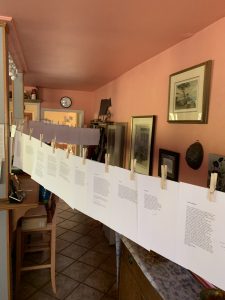 I did read some Y.A. novels-in-verse, when I first heard they were a new genre. I looked up things I thought were true but needed to make sure of, and turned out to be wrong every time. For instance, I thought a walking wheel—the great big spinning wheel you see in museums—was for spinning flax into linen, and the small ones you sit at were for wool, which is entirely mistaken. I’d invented a whole theory out of, as they say, whole cloth, about the length of flax fibers requiring a longer twist. I’m waiting for someone with an eagle eye to tell me all the other nuttiness in the text that’s untrue.
I wrote the first poem in 1998, and by 2006 had about 50 of them. I don’t remember exactly why I wrote one or five and then dropped them, or why I picked them up again. I did print them out once, stapled together for friends. The comment I remember was someone’s husband wondering if people really did have that kind of sex in 1875. “That kind” being gentle and exploratory, with conversation.
At some point in the mid-aughts, I had a brief conference with C.D. Wright at the Community of Writers. I was a little afraid of her ferocity and her mind, but I wanted to know about writing a long connected narrative like her Deepstep Come Shining. How did one do it? “If you can’t work on the poems themselves, work on something related to them, anything. Questions you could answer, background you won’t include but need to know for fleshing the work out. Try not to leave the project, because it’s hard to come back” (paraphrased). I did some of this, but also kept leaving the project, and it is hard to come back.
By 2018, though, I got serious about making a book. I spent a week at my grandparents’ farmhouse in Vermont that had no electricity or phone and boiled water to bathe in, washed my clothes in the sink, lit the wood stove for heat. I went into town for coffee, but then went back up the hill and wrote new poems in my notebook. I lay on the lawn in the dark and watched the stars. I listened to the din of the natural world and the silence of the human.
The problem was making a continuous narrative out of poems I’d written one at a time. Seasons, weather, gestation all have their timing, and I’d screwed up a lot of it, overlaying and under-reporting. One of my friends is a midwife; she helped me sort out the pregnancy. Others gave me verbatim descriptions of childbirth.
I wanted to write a book about the West that wasn’t sexist or violent, that was undramatic and untraumatic, that felt ordinary. I couldn’t stop thinking about the work they did and we don’t do any more, the crucial self-reliance. I wanted the characters to be human but nice to each other, well-meaning, happy even. I tried to balance their voices, though people say the woman gets more air-time, and that’s probably because I’m a woman and unconsciously went there. Men have described how represented they feel.
Walking Wheel is so unlike anything I’ve done before, I’m still reeling at its existence and people’s reactions. I also have no idea what to write next.
SUPPER
He sits on the bed to take his boots off,
watching her at the stove, a pinch of salt,
a stir, the way her arms reach toward things
with such confdence — gesture
second nature, or all nature:
heron plucking a fsh out of the creek,
fox leaping for his mouse.
The slight sway of her hips, moving
from stove to shelf to table and how smoothly
what she thinks of becomes true.
She makes him feel enormous and clumsy,
thick fngers at the laces, pulling socks
over his ankles, flexing his toes.
She’s a fnch to my ox, he thinks. Although
every inch of her is precious to him now,
he best likes the small of her back, that curve
as beautiful as any tool he’s used,
any frst snow drifted over a fence
of his childhood, when snow was glory.
 Molly Fisk was Poet Laureate of Nevada County and is the author of the poetry collections, The More Difficult Beauty and Listening to Winter, and the essay collections Houston, We Have a Possum; Using Your Turn Signal Promotes World Peace; and Blow-Drying a Chicken. Her radio commentary, “Observations from a Working Poet,” has aired weekly in the News Hour of KVMR-FM Nevada City, CA since 2005. Fisk has been awarded grants by the National Endowment for the Arts, the California Arts Council, and the Corporation for Public Broadcasting. She’s the Poet Laureate of KVMR and Hell’s Backbone Grill in Boulder, Utah, teaches writing to cancer patients, and works as a life coach in the Skills for Change tradition.
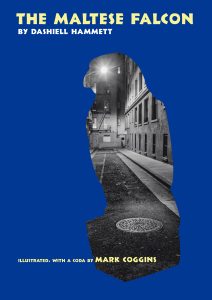
“MOCKINGBIRD” FROM THE MALTESE FALCON
by Mark Coggins
 Spade is trying to find out what happened to the real falcon by searching Floyd Thursby’s abandoned possessions.
Spade stepped off a street-car on Geary near Leavenworth and walked half a block to the Geary Inn Hotel. He went through the miniscule lobby to the desk and asked a square-chinned man with pomaded hair to speak to the hotel-detective.
“We don’t have one,” said the square-chinned man.
“Then let me speak to the manager.”
The desk clerk went away, and presently a door by the side of the reception window opened and a sleek man with dark hair and a moustache appeared. He said: “You wish to speak with me?”
Spade nodded. “A guest of yours was killed, a Mr. Floyd Thursby. Shot four times in the back—just outside the hotel.”
The manager pursed his lips and swallowed. “That is so. An unfortunate incident that had nothing to do with the hotel. May I ask what business it is of yours?”
“I’m Spade. My partner was killed that night by the same gang.”
The dark man looked at Spade and nodded thoughtfully. “So I understand.”
“The police—Lieutenant Dundy and Detective-sergeant Polhaus—would have questioned the staff, searched the dead man’s room. Did they leave anything behind? Belonging to the dead man, I mean.”
The manager drew his head back. “That’s not something—”
Spade leaned forward, the v shape of his mouth pulled taut over the v of his jutting chin. “Look, this business isn’t finished, in spite of what the cops think. If you want to avoid further mentions of the hotel in newspaper stories, you’ll play ball.”
“And exactly how will letting you examine Mr. Thursby’s possessions keep the hotel out of the newspapers?”
“I’m looking for a link to other gang members. Gang members the police haven’t caught. Now, do you still have anything of Thursby’s or not?”
The manager looked down. “Mr. Thursby had a valise with clothing and other personal items. The police didn’t take it, and no family members have claimed it.”
“Let’s see it, then.”
The manager clasped his hands behind his neck. “All right,” he said at last. “Follow me.”
He led Spade through a small office to a door that opened on a storeroom. He took a scarred cowhide suitcase from a shelf and brought it to a library table where he placed it on its side. “This is it.”
Spade’s thick fingers undid the catches and sorted through the contents with deliberate care. Shirts, socks, a union suit and a new package of handkerchiefs were examined and set to one side. He opened a box of thirty-eight cartridges and took out a round, grunting while he held it to the light. “The brother of one of these got my partner.”
“You have my condolences,” said the manager.
Spade made no reply to that and set the bullets aside. He reached into a side pocket of the suitcase and drew out a matchbox and a stack of paper. The matchbox was bright red with the words Shanghai Low, 532 Grant Avenue, San Francisco printed in a typeface meant to mimic the brush strokes of Chinese characters. The uppermost paper from the stack was folded into quarters, and when unfolded was revealed to be a receipt or bill written in a foreign language. Numbers written on the receipt indicated two of something had been ordered, but the price for the item was given in a foreign currency, so its cost was unclear.
The remaining papers in the stack were all copies of a wanted poster from Hongkong printed in English and Chinese. The wanted individual was named Huang Xiaolin, alias “Big Ears,” and the picture seemed to corroborate the nom de guerre. A lumpy-faced individual with protruding ears and fleshy lips, Xiaolin appeared to be in his early thirties and was pictured in a silk shirt with a mandarin collar.
Spade folded one of the posters into quarters and put it and the receipt into his jacket pocket. “I’ll hang on to these for now. Thanks for your help.”
A puzzled look spread over the manager’s features. “I can’t see what help it’s been, but you are welcome.” He hesitated. “And you’ll keep the house out of any future scandal?”
“I’ll do my level best.”
Spade went back to the lobby and out the front door. As he crossed the threshold, a bullet kissed a hole in the door-frame inches from his nose. Another ventilated the crown of his hat. He fell back inside.
♤
Effie Perine held Spade’s hat, wriggling a finger through the hole as she stood by his desk. “It’s a miracle you weren’t killed. Did you see who it was?”
“I was too busy trying to bite the floor,” he said from his swivel-chair. “I have a pretty good idea, though.” He cocked an eyebrow at the girl.
She frowned at him. “Samuel Spade! This isn’t a game. Who then?”
“Polhaus came by to sweep up the glass and comfort the living. He let slip that Wilmer Cook escaped from jail.”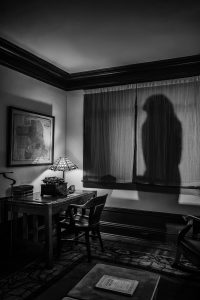
“The boy who was working for Gutman?”
Spade reached for his tobacco and papers. “Yeah, the gunsel. But he killed his boss in the end, and before that, he let Floyd Thursby have it right in front of that selfsame hotel.” Spade finished rolling his cigarette and chuckled.
“What’s funny?”
“I had just finished assuring the hotel manager that I would keep his joint out of the papers. He’ll be the lead story now.”
Effie Perine sighed and reached for the pigskin lighter. She flicked it under Spade’s cigarette. “I knew that Russian was trouble. I never should have let him in the office.”
Spade leaned back to draw on his cigarette. “We’ve got to make rent somehow,” he said as he exhaled smoke.
“What will you do next?”
He pulled out the papers he had taken from the hotel and held out the receipt. “It’s as much what you’ll do. Thursby had this in his suitcase. I think it’s a bill of sale for two lead copies of the falcon, written in Turkish. Can you get your cousin the professor at Berkeley to ask one of his egghead buddies to confirm that?”
“I could do that,” she said, curiosity replacing her previous scolding tone. “What would it mean?”
“It would mean that we would need to give Mr. Floyd Thursby a lot more credit than we have. That he didn’t show O’Shaughnessy the blind loyalty that everyone said he did. Instead of being crossed by her, he crossed her. He contrived to have O’Shaughnessy end up with one fake, either by substituting it after she stole the real one from the Russian or by taking the real one directly from the Russian and leaving the copy for her to steal. Then he left a second fake in the Russian’s trunk so he wouldn’t tumble to the theft until well after they were gone, if ever.”
Color rose in the girl’s cheeks. “What did he do with the real one?”
Spade plucked a shred of tobacco from his lower lip and smiled up at her. “I can’t say for certain, but if I were Thursby and I were dippy enough to stick with O’Shaughnessy after taking it, I might do as she did and find someone on La Paloma to transport it from Hong kong to San Francisco before jumping on the faster boat with her.”

MY BROTHERS, YIN AND YANG
Bill was a sniper in Vietnam. Dave was an anti-war activist. Together they shaped me in ways I’m still trying to understand.
by Martin J. Smith
I became a liberal when I was twelve, and still remember how and when it happened. It was 1968, and I watched through the windshield of our family’s whale of a Buick LeSabre as a young woman attending an anti-war protest in Washington, D.C., crossed the intersection where we were stopped. She wore bib overalls and no shirt, and as she stepped off the curb into the crosswalk, whomp, there it was. An actual breast, the first I ever remember seeing.
The social upheaval swirling around our car that day faded from focus as my adolescent attention narrowed to that single, unbound marvel passing before my repressed Catholic eyes. I don’t recall her face.
I was alone in the back seat, and my parents turned around to see if I had noticed. I pretended not to. But in retrospect, I’m pretty sure that was the precise moment when I decided that, like my older brother Dave, I was definitely against the Vietnam War into which our oldest brother Bill was about to plunge.
* * *
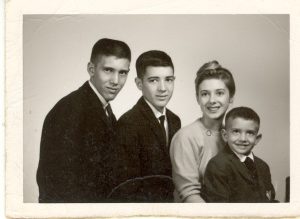 Brotherhood is a complicated bond under any circumstances. I’m the youngest of four by a decade. The others arrived in a tight cluster during and after World War II. Ten years later, I came along. (Let’s go with the term “miracle child” rather than “accident.”) To me, they were teenage aunts and uncles more than siblings, and I grew up worshiping each of them.
My sister Lisa was simply my best friend. I adored her until the day in 2015 when she died, just a month shy of seventy-three. But I had a clear choice between two potential male role models. Bill was twelve years my senior, and Dave was ten years older than me. Both seemed heroic, if in vastly in different ways.
Like today, those were divisive times. Back then, Bill was about to leave for Vietnam’s Mekong Delta. He’d enlisted in the U.S. Navy and was specially trained for its new Mobile Riverine Force, hardened, engineered, turned loose with seven other lethal children on a floating napalm cannon nicknamed Zippo 5. Officially, they were charged with defoliating the riverbanks of the Mekong River, a basic seek-and-destroy mission intended to keep the U.S. patrol and supply boats navigating South Vietnam’s vital waterways safe from shoreline attacks.
Of course, it was never that simple. Firefights were an almost daily hazard, and eventually would claim four of Bill’s original seven crewmates. Zippo 5 sometimes burned people alive. My oldest brother returned from that war
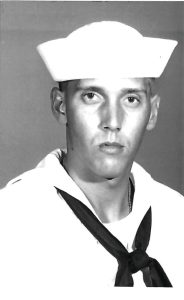
with two Purple Hearts, though it would take him fifty years to start talking about those combat experiences. When he did, I listened and turned some of those stories into “27 Knots,” a novel which Open Road Media will publish this coming November. But to me back then, he was a highly decorated cipher.
Dave, on the other hand, spent that war in the streets. A student at Jacksonville State University in Alabama, he’d embraced a role in the anti-war movement after military recruiters rejected him. They cited the total blindness in his right eye, the result of a childhood rock-throwing incident.
His hair was long, and even at twenty he rocked lush muttonchop sideburns. Dave listened to Dylan and Joan Baez, and claimed to know Baez’s then-husband, the famous activist David Harris. He organized peace and civil-rights protests on campus, and among his lefty contemporaries in that small corner of the American South brother Dave had emerged — much to our father’s chagrin — as an outspoken radical and leader among the kind of people who included young women who walked around in bib overalls with no shirt, with at least one perfectly mesmerizing breast.
* * *
For most of my life, I knew very little about what Bill did in the war. From the few pictures he shared, I knew he served on a small river patrol boat that spewed napalm from two turrets on its bow. I didn’t understand his specific role on that crew until almost a year into his tour, when our mother got sick and her doctors thought she might die. Bill was granted an emergency leave to come home to see her and arrived at the hospital in Pittsburgh wearing the same camos he’d been wearing when a helicopter plucked him from a tree in the jungle canopy.
He was dressed like that because, it turns out, my brother was a sniper.
Bill decided to rejoin Zippo 5 and its crew after his emergency leave, even though he was given the option of not returning to combat. He explained cryptically that he’d left his crewmates without a proper goodbye, and that he felt his job there was not yet finished.
Over the decades that followed, in unguarded moments, Bill let slip a few details about his life as a young American caught up in a controversial war. They were only glimpses, usually offered as part of a story to which he could affix a punchline or recast as the foibles of military life. Occasionally he’d share something more troubling, but for the most part I knew only that he’d come home alive and seemingly unaffected by what he’d seen and done, and that he seemed to shift gears smoothly into life after combat.
After his discharge, Bill married Sue, fathered two daughters, and began building a career as a financial advisor. He followed an opportunity to South Florida, and he and Sue raised my nieces in that sun-kissed land of wealth and privilege. Our politics diverged. Years passed, life happened, and my brother seldom talked about his time in what’s remembered as the “Brown Water Navy.” If you didn’t see him at his daughters’ weddings — among the few occasions when he wore his beribboned dress uniform with his medals pinned to his chest — you’d never know he was a proud American warrior who’d witnessed the worst of the tragedies and excesses of the Vietnam War.
I’m no psychologist. I won’t pretend to understand how he has managed to carry his secrets all these years. I do know this: He attends Mass daily, and often shows up early to pray the rosary. He generously contributes to strangers in need. At eighty-one, his life is focused on God, his children and grandchildren, and on trying to help others whenever he can. He is a kind and humane man who, during a brief period in his distant past, was asked to do sometimes inhumane things.
The oft-told story of the troubled Vietnam-era veteran is haunting and familiar. Many of those stories are slow-motion tragedies played out not only by the veterans themselves, but by their wives, children, extended families, and employers. But my brother Bill’s courage since the war seems every bit as impressive as his courage in combat. It’s a story of a physically and morally wounded warrior who absorbed the horrors he witnessed and carried on as best he could. He built a life and a career. Raised a family. Found space in his head for both old nightmares and the possibilities of life beyond them.
* * *
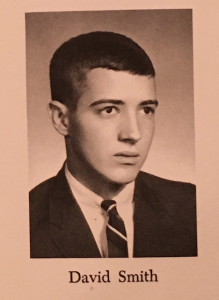 Since Bill didn’t talk much, Dave was much more accessible to me during my formative teenage years. His anti-establishment, raised-fist life seemed infinitely more interesting to a kid struggling to find his place in a world that, like now, was convulsed by political and social unrest.
According to family lore, Dave once was detained for throwing chicken manure on the steps of the U.S. Capitol, and occasionally spoke of himself as a perceived threat to America’s entrenched powers. He hung out at collective farms, worked fields in the nude, spotlighted the protestable issues of the day by sharing his opinions and his record collection.
Early on, though, there were hints of something darker that in retrospect involved clear self-absorption and paranoia. Deep into middle age, Dave remained convinced that his college-era anti-war and civil rights efforts had put him in the sights of the Federal Bureau of Investigation, and for many years believed the domestic intelligence agency kept a file on him. At one point, during a period when he was regularly drunk-dialing me late at night, I filed a Freedom of Information Act request for that supposed file to prove that he wasn’t being monitored.
Unfortunately, his name did turn up in a single, heavily redacted college campus incident report from decades earlier. That was enough to fuel his delusions.
Dave carried his radical persona like a grudge through a spotty career as a retail manager, and through a marriage that eventually unraveled due in part to his intransigence. His two children grew up mostly without him, and for decades he wore his seething contempt for his ex like a battle scar. The bitterness was, to me, inexplicable.
We all worked hard to understand Dave’s anger, and his fondness for booze and weed. Trauma? Mental illness? So far, none of us have solved that dark puzzle. I’m happy to report that he softened a bit as he got older, and seemed aware that his chosen path was perhaps not the best one.
Before all that, though, and to my adolescent mind, he was one of the cool kids. I admired his idealism and willingness to challenge authority. Plus, he pissed off my dad — which had definite appeal during my teen rebellion years. And so my position on the Vietnam War and civil rights calcified. I remain a reflexive, left-leaning Democrat to this day — even as my trust in both major political parties has eroded, even as the black-and-white certainties of the world have faded to the same gray as my hair, even after my brother Dave’s life devolved into an avalanche of prolonged bitterness, substance abuse, and self-deception.
Dave sometimes attended the every-other-year reunions of our extended family, and I never saw him drink at those, or during the sporadic visits we had. In 2018, even as his health began to fail, Bill and I were able to coerce him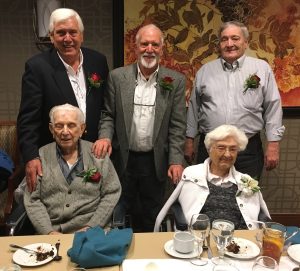 into traveling to Pittsburgh for our parents’ shared March 3 birthday. Dad was turning a hundred, and Mom ninety-six.
Our older sister had died by then, so their three surviving boys shared a guest room at our parents’ nursing home. As the youngest I got a hard cot between my older brothers’ double beds. Their stereo snoring sounded like I was sleeping in a sawmill, but I savored it. I suspected it would be the last time we’d ever be together, and it was.
* * *
The end came for Dave sometime around Sept. 11, 2020, in a small apartment in Panama City Beach, Fla., that I’d never had the heart to visit. Death came suddenly and naturally, probably a massive heart attack, during the Covid-19 lockdown and just a few weeks before his seventy-fourth birthday. No one is sure of the date because he was alone, the inevitable result of decisions he’d made throughout a life that, to me, seemed like an endless avalanche of pointless battles and bad choices.
Still, Dave influenced me in countless ways — everything from my taste in music, to my cynicism about American military interventions, to my commitment to social justice and the environment. I wore sideburns for a while in college, and like Dave’s hero David Harris channeled my impulse to make a positive difference in the world into journalism. But I also made specific choices along the way precisely to avoid the calamities I’d witnessed in his life.
And at some point, I began to model my life after my brother Bill’s.
Like him, I focused on raising my family and being a decent human. I veered from the course Dave charted, recognizing its essential sadness and the often distressing consequences of a life lived in constant rebellion. I worked hard at jobs I thought mattered, and found less abstract ways to change the world than pursuing “peace” and “justice.” As a younger man I volunteered for Big Brothers Big Sisters of America, and at age sixty-two began building Habitat for Humanity houses where I live in rural Colorado. I can see the future improve for those families, and for me that’s enough.
Still, I crank up Dylan from time to time and remember the choice I faced when I was twelve, when raging hormones and a passing miracle in bib overalls combined to influence the role model I chose at the time. I still admire the idealist and social-justice warrior my brother Dave was back when his complicated future was unrealized and unimaginable, but I also admire the quiet courage my brother Bill has modeled for me in the decades since.
At this point I know it’s possible to love two very different men equally. And while I can’t say if I’ve succeeded, I’ve had the privilege of trying to be the best of each.
ON GUNS (AND THE CURSE OF HESTER GARDENS)
by Tamika Thompson
When I was four, I picked up a handgun. Playing dress-up in my parents’ bedroom, while my mother ironed our clothes in the next room, I reached inside the jewelry box on her dresser and clipped on gold earrings, dangled bracelets from my wrists, and loaded my neck with strings of pearls. That day I even tried on her newly purchased footwear, and that’s how I discovered her revolver, lying quietly in a shoe box under my parents’ bed.
I lifted the heavy metal from its cardboard resting spot. A residue of oil coated my fingers as I turned it over, using both hands to hold it up. I wanted to show it off to my mother, to ask her about it, to find out whether it was a toy for me or my older brother, so I carried the gun to the next room where my mother stood at the ironing board, a spray bottle of starch sitting at the edge.
I can’t remember whether I said, “Mommy, look,” or some such excited phrase upon entering, but when our eyes met, her cheeks grew crimson as she calmly, slowly stepped forward and took it from me, careful to point the barrel toward the floor.
I didn’t know it at the time, but the gun was a gift to her from her older brother. The weapon was old, with a trigger so tight it took a lot of strength to pull it, she’d later share. My tiny hands barely fit around the single action revolver and would have been hard-pressed to cock the hammer and fire, but the piece was fully loaded, with six bullets that could have struck us if I’d dropped it.
Without a word, she walked the firearm back to their bedroom. I was hot on her heels, peppering her with questions she did not answer. She never turned to look at me as she returned the gun to the box and placed it high on a shelf in the closet. She redirected me with a shush and a shoo, and that was that. Forgotten immediately until that night as I lay in bed.
Weren’t guns make-believe? I wondered.
I’d already been shot in the chest by a bullet fired from my older brother’s BB gun that had ricocheted off a tree. I’d been knocked down, surprised, and stung by the pelting, but I’d survived.
It was all pretend, wasn’t it? Then why did my mother take the toy from me and place it far away? Why didn’t she want me to play with it?
*
By seven, I knew where many of the guns were in our thousand-square foot, two-bedroom home on Detroit’s westside. This is probably where I should mention that we lived in the Motor City at the height of the crack epidemic, when forced entries, muggings, and carjackings were pervasive. Even when my hometown wasn’t the “murder capital” of the United States, it was still a big city, replete with all the issues one would imagine. My mother grew up on Detroit’s eastside, where, beginning in middle school, fistfights and stabbings were the norm. She’d graduated from a Catholic high school and settled into work as a secretary in an office building downtown. My father, who was raised on a southern Alabama farm, had become a card-carrying member of the United Auto Workers, where he worked late-night shifts. They often stayed overtime to afford Catholic school for my brother and me.
For self-defense and sport, my parents housed one fully-loaded revolver in a bottom drawer of my mother’s dresser. A pistol they kept in the cabinet above the fridge wrapped in a brown paper bag like a bottle of liquor, also loaded. My father had zipped his hunting rifle inside a carrying case that hung on a hook near our basement steps. There was a handgun in the dining room curio. I suspected he also had one in his safe, and I figured several more of his shotguns had spots in our garage. My friends all knew where the firearms were in their homes as well. When I visited them for parties, playdates, and sleep-overs, they often pointed the weapons out to me. “There’s my dad’s heat,” they’d whisper, in seeming deference to the sidearm’s power.
*
By 10, I was better versed in guns and how deadly they were. My father had a hunting license, and I often helped him process rabbits and cook the deer he killed. I’d flip through his Bass Pro Shops catalogs and peruse his Field & Stream magazines. I have a vivid memory of him stepping into his blaze orange hunting bib, explaining to me for the hundredth time that the color was to avoid being accidentally shot by another hunter.
My mother didn’t allow me and my brother to go hunting with my dad, so chatting him up as he headed out and awaiting his return was my way of being a part of this fascinating sport, one that made him smile, his face looking younger and sunburned each time he returned.
It was also about this time that I had a recurring dream in which I discovered the revolver under my parents’ bed, walked it up to the ironing board and accidentally shot my mother. In another, I opened the cardboard box and unwittingly killed myself. That dream featured bright lights, a loud pop, and blood. So much blood.
*
On some deeper level, my subconscience must have already known how deadly guns were from the beginning, even before my parents’ warnings, well before I handled a gun myself. When I was a toddler, before the recurring dreams, before the shoebox, someone shot my uncle through the chin, killing him and shattering my family.
Then things got worse.
Most of the families on my block with kids I’d grown up around had long since moved away. The folks who could afford to leave, did. Many of the folks who stayed had problems or caused them—drug sales gone wrong, arguments that turned into fistfights which quickly became gunfights, carjackings, drive-bys. So many drive-bys. I can still hear the Pop. Pop. Pop. sound followed by screeching tires and screams.
Drive-bys scared me the most because anyone standing on their front porch or riding their bike down the street could be shot to death. Sometimes people were killed inside their homes when bullets penetrated windows. I saw a lot of dead kids in the news in my city who had been struck down while playing on their lawns, porches, in the street-facing rooms of their home, or while riding their bikes. My parents had a rule that my brother and I had to hang out and play in our backyard. Never out front. I was young enough to complain about it, but I also did what they said. In my neighborhood, not following rules could end in death.
Police raids were common in my neighborhood, with officers breaking down front doors with battering rams. I was warned off of speaking to police (snitching) or calling them in emergencies. If I was in danger, I had to phone my parents or another armed adult who could get to me in a hurry. My parents made sure I understood that since we were Black, the police would be more likely to shoot one of us than help us.
Helicopters flew overhead on a regular basis, and in the summertime, when I raised my window to let in a breeze, their searchlights would wake me as it shown into my room, the brightness passing over my body as it went.
A close family friend was shot to death not far from his high school.
Several of the men in my extended family died by gun, while driving on the freeway, while standing in their driveway, while walking down the street, often by shots fired from passing vehicles.
At fifteen, I survived an attempted carjacking.
When I turned eighteen, as soon as college started, I got the hell out of Detroit with no plans to return. On the drive to the airport, my stomach churned as I looked out at my city in the rearview. I would attend college and put all of this gun and violence stuff behind me. Or so I thought.
*
At Columbia University, I studied political science and took several courses in African American studies, history, and politics, with celebrated scholars like Manning Marable, Winston A. James, and Anthony Marx. I quickly saw that what I’d experienced in my youth was by design—“American Apartheid,” one book called it, which was part and parcel of slavery, the dismantling of reconstruction, enactment of Jim Crow laws, segregation, and attacks on voting rights. I saw that law enforcement itself had grown out of the need to control enslaved people in the south. That the American empire was built from land seizure, enslavement, war and militarism, and that the gun was synonymous with American power. It became impossible to have discourse on American hegemony without also discussing the proliferation of gun manufacture and private ownership of firearms.
When my studies included images of war-torn nations overseas—ongoing civil war that impacted the children of Sudan, for instance, or Palestinian and Jewish youth affected by their continuous conflict—I identified with them. Not only did I see myself in the children who were traumatized on a regular basis by gunfire, bombs, raids, and police over-enforcement, but I also discovered that American imperialism contributed to the conditions in which we all lived. U.S. guns weren’t only showing up on U.S. streets and in the hands of our military and police, but were also making it into the hands of U.S.-backed opposition forces abroad. The Iran-Contra Affair, for instance. Or in Haiti, where gangs used illegally trafficked U.S. guns at the same time that the United States was legally providing military power to Haitian police forces. I was seeing the violence from my Detroit street play out all over the world.
As a journalism student at the University of Southern California’s Annenberg School for Communication and Journalism, my beat was Inglewood, California, where I quickly took up the work of talking to Bloods and Crips, understanding gang culture and how the conditions of the urban ghettos directly contributed to the creation of the groups—poor education, dilapidated housing that often causes injury and illness, lack of investment in the neighborhood, no jobs, no healthcare, no resources. Quite often, the gangs were filling in the gaps of malicious social policy by providing an informal economy, de facto protection from predatory police officers and landlords, crime investigation, street justice, cash loans, and intelligence, particularly as it related to dirty cops. The ones I spoke to were also implementing inter-gang truces and reconciliation where they could.
This checked out with what I knew from my own experience, when crime-affiliated members of my family paid for my school tuition or gave me money to keep my phone on. Often, these were grants, not loans, and I had few other sources of capital at the time.
I ventured out to speak to former members of Mexican-American gangs, whose stories were very similar to the members of the black gangs that made up the Bloods and Crips. As young people, they were often living in awful conditions and also traumatized by their environments—a loved one had been shot and/or killed, they had witnessed beatings, they were beaten by a loved one or neighbor, they were assaulted by police or witnessed it happen to someone else. These were in their formative years, when they were younger than 10. The similarities across gangs, ethnic backgrounds, and cultures had been unexpected.
I went on to work at NBC News and later for a PBS television show, but I couldn’t turn off the part of me that had connected with these stories. And it wasn’t just those stories. It was also mass shootings and school shootings that were turning up in the news. And then one day, everything changed for me.
On December 14, 2012, just eleven days before Christmas, a twenty-year-old man shot and killed his mother and then arrived at Sandy Hook Elementary School in Newton, Connecticut, where he killed 26 teachers and students. Many of those who died were in first grade.
The nation was rightly shocked. Devastated. With many victims being only six years old, tiny, defenseless, some hiding in closets based on previously established school shooting lockdown protocols, the fallout from this event was palpable.
At the time, I was the young mother of a 20-month-old, and I thought: This is it. We’re finally going to have a national conversation about gun violence, with discourse on how we can once and for all protect our young.
But no one could agree on a solution, opposing sides seemed to grow even more polarized on television and in newspaper opinion pieces, and within weeks, the news cycle moved to other topics.
I was outraged. First graders? Was nothing sacred? Did a line even exist that we as a nation were unwilling to cross? Certainly, we weren’t going to just sit around and watch our children die.
*
In earnest, I researched youth violence in America in what I’d thought would be a documentary on the subject. I spoke to survivors, parents who had lost children in shootings, law enforcement, think tank experts, staff at the CDC, municipal leaders that had put together task forces to address the issue in their towns. What I found was both heartbreaking and hopeful.
Gun violence in America is an epidemic and public health crisis, a declaration made in 2024 by former U.S. Surgeon General, Vivek Murthy. The stats from multiple public health and NGO sources paint a horrific picture:
- Gun injury is the leading cause of death for young people in this country;
- Each day, an average of 132 people die from gun violence—one death every 11 minutes—and this number includes suicides, homicides, and accidental shootings;
- In 2023, around 48,000 people died by gun; 27,300 people by firearm suicide, 17,927 by firearm homicide, an estimated 604 fatally shot by law enforcement, and 463 by unintentional gun injury.
But the real eye-opener for me? Experts told me that before a young person ever picked up a gun, they most likely have first witnessed or have been victims of violence at home, in their community, or at school. That is true across all socioeconomic factors, environments, and ethnic backgrounds, which is why those gang members from completely different cultures all had similar stories—tales of trauma akin to that of the mass and school shooters as well.
*
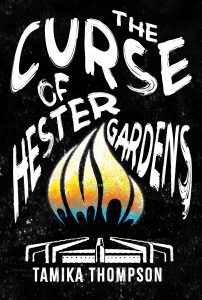 Which leads me to The Curse of Hester Gardens. This book, my debut novel, gathers my lived experience, the research, the pain, the confusion, and encapsulates it in one text. I hope it will be a national conversation piece. It is a truly American book, bringing together all of the things that we face and don’t want to discuss: poor housing, racism, the prison-industrial complex, law enforcement, education, militarism…violence, in its myriad forms.
I must state plainly that the characters in my book are not villains. None of them. Not even the gang members. Especially not the gang members.
The text follows one mother’s attempt to break a horrific cycle of homicide in her neighborhood. Nona McKinley raised three boys in a Michigan public housing project called Hester Gardens, where crime is high and guns and drugs are pervasive. She is facing the worst possible odds with her husband behind bars and her oldest shot to death at eighteen, and she struggles to keep her remaining sons alive and thriving. There is a curse that seems to want her boys, and Nona fears she’s not strong enough to save them.
The setting of Hester Gardens highlights the facts of American life that are felt by us all. We have reached an impasse in this country, with one side saying “regulate the guns” and the other saying “this is about mental health and has nothing to do with guns.” And as with car accidents and cigarettes, gun violence is a preventable public health crisis that must be tackled through a non-political lens.
My late father, the hunter, would likely not want guns regulated in a heavy-handed way. My family members who own guns would likely balk at the idea of any more regulation on their weapons than already exists. They are not alone. Americans own nearly half of the world’s civilian-owned firearms, and our ownership rates far exceed those in other high-income countries. Forty-six percent of U.S. households report owning at least one firearm.
The demand for guns remains high, and I believe this is why in some states, and certainly nationally, gun regulation is an uphill battle.
My gun-owning family members, past and present, are part of this demand. And yet, they would probably all agree that AR-15 style rifles, the seeming weapon of choice in mass shootings, could use some more regulation. The thinking on that is supported by a look at states with more gun regulation in general. Regulation goes up, death-by-gun goes down.
And the pro-gun folks who discuss mental health and investing in social programs are right about that. The city leaders I spoke to all those years ago who were seeing some success in getting their gun deaths down had really done multiple things at once. They invested in mental health programs, safe gun-storage education, social programs that increased jobs and rehabilitation for at-risk youth, they trained law enforcement in community policing, with an eye toward creating connections with the people in the area that they were tasked with serving. And since I’ve been able to watch these trends over time, I’ve seen that when the investment dollars go away, so does the progress.
I hope that the story of Hester Gardens, a community of families surviving in a high-crime public housing project, highlights the fact that safe communities should exist for everyone, not just for the wealthy. I hope the text pushes back on deeming certain neighborhoods okay for violent crime to occur, with law enforcement and government policy primarily being used to contain residents in these areas and keep them out of “safe” communities. Language like “up and coming neighborhood,” “rough area,” “troubled neighborhood,” “ghetto,” “slum,” “hood,” should be challenged because they remove the sense of responsibility we all have in ensuring dangerous neighborhoods don’t exist in the first place.
As for shootings in particular, one of the quickest ways we can wrap our brains around this national tragedy is to stop talking about gun violence as separate categories. We let down our guards when a shooting is targeted versus a random act of violence. We let down our guards when a domestic killing or a murder-suicide occurs, even though we know that with these mass shootings, domestic violence is often a precursor. We don’t call drive-by shootings mass shootings when we should. We don’t lump inner-city shootings that happen at school bus stops or at school-sponsored sporting events in with school shootings. We don’t see so-called gang shootings as akin to school shootings and mass shootings. And this need we have to codify and categorize, and this desire to put ourselves at ease is costing lives and livelihoods. Not only are we looking at 48,000 Americans killed each year by guns, but there are also an additional 32,000 non-fatal gun injuries. An average of more than 200 Americans visit the emergency department for nonfatal firearm injuries each day—entire families and communities shattered across the country daily, and I’ve experienced that shock and grief. I’ve survived that pain.
Having lived this, having researched this, having written this into a novel, I’ve concluded that gun violence in America isn’t actually a political issue. Both sides can be right. We can reach consensus on what to do because I think the majority of people on all sides of the issue no longer want to live this way. Private gun owners and people who want the shootings to stop are one and the same. Don’t let anyone tell you different.

INTRODUCTION TO WE RODE THE RHYTHMS: ON THE POETRY OF ETHERIDGE KNIGHT
by Norman Minnick
On the first day of an Honors Seminar on Etheridge Knight at Butler University, I asked my students to explain why they chose this class over others that were offered. One was studying prison reform. Another was a spoken word poet drawn to Knight’s role in the oral tradition. Others were interested in addiction and recovery, veteran’s affairs, and civil rights struggles. One or two admitted that it was the only class that fit into their schedule.
I also asked them what they might be apprehensive about at the start of the course. I admitted that mine had to do with a recent class visit at another university where a student asked me about Knight’s use of vulgar language and raw subject matter in poems like “Feeling Fucked Up,” “Dark Prophecy: I Sing of Shine,” and “Fuck Now/Pay Later” and how they might be received by a younger generation. Neither time nor patience allowed me to unpack this, so I posited the notion of Knight as a truth-telling trickster; someone who doesn’t fit neatly into any category of today’s tribal milieu. His poems are, as Frank Allen notes, “the throaty, uncomfortable, wrinkly, idiomatic, irregularly vigorous kind of poetry” in contrast to “the structured, upper-middle class, intense, deeply informed, with bright, high gloss” kind. This is what I was prepared to teach my students. Akin to the Japanese practice of kintsugi, I wanted my students to know a poet who was unique and beautiful because of his imperfections and scars.
The great jazz pianist Bill Evans once remarked that there are no wrong notes, only wrong resolutions. In jazz, imperfections are often seen as opportunities. They are the result of risk-taking. Miles Davis was known for his flubbed and cracked notes, which have become a part of his aesthetic. Because flaws in jazz sustain the value of improvisation, the resolutions of the imperfections are what we should be paying attention to. (Evans and Davis came together to record Kind of Blue, the bestselling jazz album of all time. Knight was twenty-eight.)
Like the jazz musician, Etheridge Knight is a poet who, according to Sonia Sanchez, “made the line become jazz.” However, Sanchez didn’t believe that Knight was a jazz poet. “He wrote some exquisite poems, wonderful poems with the aroma of jazz—but when you opened it up, it wasn’t jazz, it was blues.” She continues, “There is so much pain in Etheridge’s work that his poems are always infused with the blues life, the blues style, the blues way of looking at the world.”
What I was less prepared for in that deep dive into Knight’s life and work were the myths and varying contradictions to which I could not answer. The one that stands out the most is Knight’s often repeated apothegm, “I died in Korea from a shrapnel wound, and narcotics resurrected me. I died in 1960 from a prison sentence and poetry brought me back to life.” While Knight did become addicted to narcotics, serve time in prison, and discover poetry while incarcerated, the fact that he suffered a shrapnel wound is in doubt. As he discusses in the year before his death in an interview with Elizabeth McKim (excerpted here from Freedom & Confinement, University of Pittsburgh Press),
Seems to me people would read that quote as a metaphor. It came out of a letter I had written to Dudley Randall when I was in prison. I was talkin’ about bein’ alone and in a lot of pain. I didn’t think people would take it literally. After all, I did say I died! It was a psychic wound.
Some even question the claim that he served as a medic in the Korean War. Many of Knight’s military records were destroyed in a fire; however, some charred remains are in the archives at Butler University. According to these records, Knight did in fact complete a Med Tech course in May 1950, but no documentation has surfaced to prove he served as one in the war.
In a review of The Essential Etheridge Knight (1986) Raymond R. Patterson points out that the book, “contains the stuff of myth: the ignoring of chronology in the ordering of poems; the wanderings of a hero; his initiations through loss…The essence of Etheridge Knight?” Patterson adds,
“More like the work of an experienced escape artist covering his tracks.” In an era of extreme political correctness and hypersensitivity, as stones are being hurled from all corners, Knight reminds us that one need not be free from sin to show the way to truth.
“Who today, among poets, is as exuberant and honest, as gentle and fierce, as Etheridge Knight,” Frank Allen asks. Even if this means having deep fault lines. “[Knight] would have been the first among us to stand up and say, ‘I’m not perfect,’” Yusef Komunyakaa writes in the foreword to The Lost Etheridge: Uncollected Poems of Etheridge Knight (2022), “And at that moment the mask would have shifted slightly askance.”
In a review of The Lost Etheridge, Walton Muyumba writes that he is “left wanting more textual criticism and more contextualizing literary history to help [him] understand Knight’s prowess and achievement.” That is just what we hope this book provides.
We also hope that we can clarify the narrative. Until now, for example, we believed that Etheridge Knight began writing poems under the tutelage of Gwendolyn Brooks and that he gained fame after the publication of Poems from Prison in 1968. However, Knight was a frequent contributor to Negro Digest beginning in 1965. His first publication, the poems, “Ray Charles’ Ruby” and “Johnny Mathis’ Ruby,” appeared in the January 1965 issue, a year before he met Brooks. Knight continued to publish poetry and short stories in the magazine well into the 1970s when the name was changed to Black World.
My initial vision of this book was to be comprehensive, but that would result in a book more than twice this size. Rather, my vision evolved from a collection of documents to a “book of revelations,” as reviewer Olumo described Knight’s Poems from Prison in Black World magazine in 1970, mainly with the help of my honors students who, through their inquisitiveness and perseverance, enjoyed the process of commemorating and unmasking the mythical Etheridge Knight: drug addict, prisoner, Black poet. This is where we began. They did the work of breaking him out of his cell—to see (and hear) him as more than a prison poet. As Susan Neville reminds us, “he lived most of it among academics and poets, not in prison.” This is where we ended up. (Neville visited our class, which was the highlight of the semester.)
Here we have a more comprehensive view of a poet whose mask has shifted slightly askance. But, how much can we really know Etheridge Knight?
Komunyakaa observes that while some may see Etheridge as a trickster, “the man left a legend of stories behind him. Some takes,” he continues, “were contradictory, but they were always interesting, always filled with vim and vigor, with emotional sleight of hand, always disguised by a shim of innocence.” Komunyakaa is perhaps unconsciously evoking Walt Whitman, that other American “rough” who also seems as if he “wanted to appear in contradiction, not wrestling with but embracing duality: unlettered and wise, rural and urban, good and bad, or tough and sweet, cool and uncool.” It’s no surprise then that Knight cited Whitman as a poetic influence alongside Langston Hughes, Carl Sandburg, and Gwendolyn Brooks.
The reader seeking a conventional poet, someone who fits neatly into a category or school, one who is refined and predictable and cuddly and warm, may be frustrated by the brutal honesty that draws many to Knight’s work. “He brought street poets, academic poets, jazz poets—all poets—together in one place in ways hardly any other American poet has accomplished,” writes Neville, “Maybe Allen Ginsberg, but still, no one was ever quite like Etheridge.”
Knight’s poetry and presence were defined by a communal spirit that bridged the gap between the street and the classroom. His brutal honesty was unfiltered, even when performing for younger audiences. He sought to connect with people of all ages, aiming to evoke emotion and bring them together through the power of poetry. Throughout this book, you’ll find a series of letters from students following Knight’s many visits to K-12 classrooms. The public persona of the ex-con, ex-junkie, radical voice is countered with young students thanking him for classroom visits, almost like a trusted uncle stopping by to talk about poetry. These letters offer small islands of delight among the scholarly documentation, personal and critical essays, and other elements of the complex biography of Etheridge Knight.
As my bright and sagacious students came together in the Honors Seminar to help compile this collection of letters, interviews, and essays, they developed a strong kinship with a poet who, in the words of Victoria Atwater, “poured his heart and soul into everything he wrote.” Yet, as we look back at the complicated life of this influential poet, it is to the younger generation of poets and readers we should look. Knight wrote on a scrap of paper found in the Butler archives, “If I’m dead when you read this, don’t pay much attention to me. Pay attention to live Poets, Poets preferably of your generation/time.”
At the end of the term, I invited my students to reflect on their experiences. Rather than summarize their sentiments, I’d like to include them here in the frank, honest, and beautifully articulated way they were presented to me. They should have the final say.
What do you hope a reader familiar with Etheridge Knight gets from this book? What about a reader unfamiliar with Knight?
I hope people understand Etheridge’s humanity. Yes, he was a talented poet, but more, he was a devoted poet. As you’ll see in his letters and interviews, that man felt emotions deeply. We [can] see he had to intensely dedicate himself to poetry It’ll take just a few pages to realize how wholly he was able to captivate such raw emotion, and I hope readers will appreciate how seen they have the chance to feel by reading anything he wrote.
—Emily Adamowicz
Although I never met Etheridge, I feel like I know him. Ultimately, that feeling is what readers of his work should take away. Etheridge poured his heart and soul into everything he wrote. His poems are filled with raw and authentic emotions ranging from being smitten to downright pissed. In my opinion, Etheridge could be described as the crazy uncle in everyone’s family…I can connect some of his traits to characteristics of my own family members. Moreover, he had a universally appreciated personality as demonstrated through letters, essays, interviews, and our guest speakers. All in all, the main idea or summation of Etheridge that someone should take away was that Etheridge was a poet who expressed all emotions in his work and was authentically himself in every way.
—Victoria Atwater
For readers familiar with Etheridge, I hope they feel even closer to him after reading a book of his letters and interviews. I really think the letters will be key to this. I hope that they begin to see him more as a friend and not just a famous poet who is some sort of distant figure. Based on what I have learned about Etheridge, I truly believe that he would want to be remembered as an equal who just happened to love to create meaningful poetry.
For readers not familiar with him, I hope they feel the same way I do. I went from never hearing his name or hearing any of his work to being able to describe what type of person he is, his quirks, and my favorite poems of his. I hope they learn that he is not a prison poet; he is a poet who wrote some of his poetry while in prison. I hope they see both the good and bad of him and realize he is human like the rest of us.
—Anna Childers
I hope that new readers to Etheridge can enjoy the emotional charge of the poems. Being in love is such a universal experience and I think students could definitely benefit from their feelings being shown and therefore validated.
For readers familiar with Knight, I would want to pick a specific subject/motif in his work to go deeper into. Throughout reading the interviews, I believe talking about Oral Tradition and Blues would be my topic of choice. Through letters, interviews, poems, essays I believe we could capture the beauty and importance of Oral Tradition in Etheridge’s work and beyond. That could be an interesting starting point to then talk about blues, how the Black Arts Movement influenced them, the repetition found within them as a form to denounce injustice/grieving, and Etheridge’s take on it.
—Diana Fernandez Caumol
For familiar readers: Further expand the evidence of his contradictory nature, relationships, and all the women in his life. Those are the important pieces of nuanced context any familiar reader might need to better understand his person and poems.
For unfamiliar readers: Introduction to his poetry, the workshop, the muses in his letters, his humor, and most importantly his voice. While the medium of the novel may constrict that last one, hearing his voice was by far the most impactful thing throughout this process. In my head, poets are old with soft voices and hushed breaths, but Knight’s voice felt so modern. It was alive and full of life. It turned him from a figure to a tangible person in an instant.
—Keegan Jackson
I would hope that a reader familiar with Etheridge Knight can gain new insight into Etheridge as a human and poet from reading this book of his letters and interviews. I think the letters offer a different perspective on how Etheridge struggled in his life. Though this theme is obviously captured and discussed in his poems, it feels like these are more open to interpretation and applicable to individuals. When reading the letters, the emotions feel very real and personal to Etheridge, and it’s fascinating to get a true look into Etheridge’s internal monologue.
If a reader is unfamiliar with Etheridge, I would hope the collection of letters and interviews would provide a foundation for understanding who Etheridge was as a person, poet, and member of the poetry community Because he was primarily a poet, I feel like there would be some benefit to getting to know Etheridge first as a writer of poetry before reading his personal letters. On the other hand, it would possibly be easier to get to know Etheridge first through this personal view, and then as a poet. After all, even in his letters to friends and family, many of his phrases read like his poetry.
—Emily Landwehr
I hope that a reader familiar with Etheridge’s work would gain a lot more insight to him from a book of letters and interviews. For those who know Etheridge’s work, they might not know about his personal life, or even his workshops. Etheridge was such a complex person, that through viewing his writing beyond poetry, you can see much of the reasoning behind the topics that are significant to him. Etheridge shows his character through his writing by showing compassion and caring for other people’s lives…A reader who is unfamiliar with Knight would hopefully read this book and find enthusiasm for reading his poetry…I think that overall, a book of letters and interviews would be beneficial to anyone wanting to learn more about Etheridge Knight because of the diversity of all the information and the truthfulness of his character that comes across in these writings.
—Sophie McCarthy
If someone reads the completed version of the book, I hope the reader has several takeaways to understand Etheridge more. I think having the book go into depth into his different identities as previously mentioned would be interesting. Another takeaway should be the network of people he had and the communities he created. Focusing on Etheridge’s circle does a really good job of showcasing all of his different aspects and adds a lens to his poetry. For example, he talks about his partners and includes poems and letters he wrote about and to them. I also think the Free People Poetry Workshop should be an important part of the book, maybe evening ending the book with a note on how the workshop impacts the world around us. Kenneth [May] was very influenced by his experiences in the workshop and it might be interesting to further explore how Etheridge could affect future generations and be remembered.
—Ella Million
I hope readers looking to become familiar with Etheridge and his work take a similar intertextual approach, understanding him and his contributions through a variety of lenses and opportunities to engage with his voice. I would urge readers to read his interviews as informed with his work, and his work as informed by his letters and family life. This cycle continues until the reader, like members of our class community, become acquainted with Etheridge the person, prison poet, and peer all at once. This complete understanding is prerequisite for a deeper appreciation of his work, and I am grateful to have had a class that granted me a learning environment to explore an intertextual range of chances to connect with Etheridge.
—Leah Ollie
Editor’s note: I have chosen to retain certain misspellings as they reflect the vernacular of the writers, which plays a significant role in the authenticity and cultural context of the work. Additionally, some misspellings appear in handwritten letters, preserving the original voice and intent of the writer. These choices are intentional, respecting the linguistic and personal expressions of the individuals involved.
We Rode the Rhythms as One: On the Poetry of Etheridge Knight Edited by Norman Minnick (University of Michigan Press, 2026). DOI: https://doi.org/10.3998/mpub.13068270

Norman Minnick is the author of three poetry collections and editor of several anthologies. Most recently, he is the editor of The Lost Etheridge: Uncollected Poems of Etheridge Knight, and We Rode the Rhythms as One: On the Poetry of Etheridge Knight, University of Michigan Press Under Discussion Series, Ann Arbor. His poems and essays have been published in The Georgia Review, The Sun, World Literature Today, The Writer’s Chronicle, Oxford American, and New World Writing, among others.
INTRODUCING CONVEYANCES OF THE POETS
by Bubba Henson
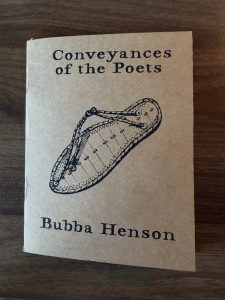 If the love of poetry and poets rises to cult level status – which it does – then I, as a poetry lover, am proud to be devoted to such a metre of characters, so rigidly themselves, rebels and not-rock-the-boaters, walkers and speed demons, streetcar operators and incompetent ship captains whose biographies, traits, and quirks point to an individualism that may or may not be subordinate to the work but is nonetheless fascinating. When I learned about Langston Hughes’ 1927 road trip with Zora Neale Hurston, I was hooked.
I bet somewhere therés someone who can tell a lot about a person from their hat, and someone else who can tell you after looking at your hat how you’re going to die, and finally, someone who could look at your car and mate it to a poet. In the text, if the pairing of a conveyance to a poet is impossible, then yes, you may be in the land of conveyance-free association, and you know what that means. The facts, however, are true.
The unalphabetized list of poets grew in direct proportion to the presence of information about their conveyances, or the dearth, equally as inspiring.
Still, it in no way constitutes a formal canon as Samuel Johnson did with Lives of the Poets. As James Tate once wrote in the last line of his poem “Goodtime Jesus,””Hell, I love everybody.”
Mostly.
Friends, thank you for reading this exploration of literary history, possibility, and story. How we move, or not, through life matters.
Curiosity rules.
John Keats Triumph Spitfire
In his short life, Keats mostly traveled by foot, horseback, or carriage, until his health sent him by ship from England to Naples, Italy, in September of 1820, to seek relief for his tuberculosis. Keats’s Italian retreat was only two years after his famous 1818 Walking Tour with his friend Charles Brown. They walked over 600 miles through the Lake District, Scotland, and Ireland, encountering mountains, local culture, and literary connections (such as Wordsworth’s home).
But had he access to semi-modern automobiles, he most certainly would have been a Triumph sports car owner. We picture Keats (we would address him by his last name, affectionately) in a Triumph Spitfire, British Racing Green, a convertible, of course, prone to electrical faults, corrosion, and engine wear if not properly maintained.
Wind in his hair, “Thunder Road” on the radio, Keats would feel every dimple in the road with the Triumph’s suspension, until he must pull over because the muffler has shaken loose. And he would say to his brother or whoever is in the bucket seat next to him, “It’s ok. This is part of it. Embrace it.” Triumph owners would agree that one must embody the very essence of negative capability in maintenance. Triumphs are notoriously finicky.
As the Spitfire sits in the shade of a dingle waiting for a mechanic to arrive, there is Keats, staring at his reflection in the driver’s side mirror. Does he see a young man “at once strongly cut and delicately alive,” as he was described by his friend and champion, poet and critic Leigh Hunt? Does he perceive himself as he did the Grecian Urn, as a symbolic mirror? Does his face reflect longing for permanence in a world defined by transience? Instead, he is trying to remember if there is duct tape in the boot, which he could use to hang the exhaust pipe.
Or maybe not. Duct tape wouldn’t be invented until 1942 during World War II by Mrs. Vesta Stoudt, a munitions factory worker who wrote to President Roosevelt suggesting a stronger, waterproof cloth tape to seal ammunition boxes for soldiers. Keats, my friend, more people may know your name over Stoudt’s, but you have to wonder: on the scales of history, which has more weight, “Ode to Grecian Urn” or duct tape?
Edgar Allen Poe Skiff
Poe was one of the first modern American writers to make a living by his pen.
Consequently, in the first half of the 19th century, he frequently traveled between literary ecosystems like Philadelphia, once the center of publishing, and New York and Boston, moving between the cities as publications hired him, fired him, or saved him. He also went back and forth between Richmond and Baltimore as emotional touchstones, the respective homes of the Allans, his foster family, and his Aunt Maria Clemm, a blood relative whose daughter, Virginia, his first cousin, he would marry when she was 13 and he was 27.
To travel the Atlantic Corridor, Poe used steamships, ferries, and railways, but his favorite form of conveyance was the ordinary skiff, a flat-bottomed small open boat propelled by oars. Contrary to the image of Poe as a fragile drunkard, he was exceptionally skilled and athletic at rowing rented or borrowed skiffs on the treacherous East River of Manhattan.
In early 1846, Poe and his wife, Virginia, and Aunt Maria Clemm boarded at a farmhouse in the neighborhood of Turtle Bay, on 47th Street. It was a short walk from there to the East River. Poe would bear north on the river past Blackwells Island (now Roosevelt Island) and fight the deadly currents of Hell Gate, a narrow, turbulent strait where the East River and Long Island Sound meet, which is particularly dangerous. The Army Corps of Engineers had yet to blast away the submerged rocks, a key contributor to the lethal whirlpools (a project begun two years after Poe died in 1849). New York City likely saw between 300 and 400 drownings per year during the mid-1840s. With a population of roughly 371,000 in 1845, this drowning rate was alarmingly high by modern standards.
For comparison, while the city today is over 20 times larger (8.5 million), it typically sees fewer than 20-30 accidental drownings per year in its waterways. In Poe’s time, death by water was a weekly, if not daily, occurrence in the city’s papers.
Poe’s rowing route included The Pot, a portion of Hell Gate with a notorious whirlpool and rock formation that created unpredictable currents capable of capsizing small craft instantly. Records show that during the mid-19th century, roughly 1,000 vessels ran aground annually in the Hell Gate passage, most of them minor groundings of larger commercial ships.
Poe was a lone rower in a wooden skiff. He found solace on the water, escaping the “din of vehicles” and the noise of the growing city. He reportedly loved the exercise and the solitude, often dragging the boat onto the rocks to sit and stare at the water for hours. Perhaps these moments contributed to the inclusion of a skiff in his short story, “The Gold-Bug,” and in The Narrative of Arthur Gordon Pym of Nantucket, Poe’s only complete novel, in which the characters survive a shipwreck in a small boat.
Stephen Crane’s masterpiece, “The Open Boat,” which also features a small boat, would not appear until 1897.
There is also the story of Poe’s infamous James River Swim, which occurred in his youth in Richmond. He bet friends that he could swim from Ludlam’s Wharf to Warwick, a distance of six or seven miles against a strong tide and hot sun. He completed the feat, purportedly emulating Lord Byron’s swim across the Hellespont. This story was a source of pride for Poe.
Edgar Allen Poe, “Master of the Macabre,” a skilled waterman.
When the city of Baltimore established a new NFL team in 1996, the franchise gave fans the chance to name the team and presented them with options such as “Americans, “Marauders,” Mustangs, and “Railers.” Fans chose the fifth option, the “Ravens,” earning the Baltimore Ravens the prize for being the first and only NFL team named after a poem. The world’s most popular sport, soccer, or football, is the only other sport to appropriate literary names. The Scottish football club Ayr United FC is nicknamed “The Honest Men” a phrase from Robert Burns’s poem “Tam o Shanter.” Not content with one poetically inspired name, Scotland also boasts the football club Queen of the South FC, which takes its name from an epithet made famous by the poet David Dunbar for the town of Dumfries. The Scottish football club Heart of Midlothian FC is often called “Hearts”,” named after a local landmark that also inspired the novel The Heart of Midlothian by poet and novelist Sir Walter Scott. Not to be outdone, a top-tier Portuguese football club, Gil Vicente FC, is named for Gil Vicente, a 16th-century poet and playwright.
Were Poe to have lived into the mid-20th century, his favorite conveyance might have been a black 1965 Lincoln Continental with suicide doors and a working cigarette lighter.
John Milton Indian Chief Motorcycle
As a systematic dismantler of Christian orthodoxy, a rejector of the Trinity, and a believer that Christ is subordinate to God, Milton was an unambiguous and comprehensive iconoclast.
Would that we could time-jump him into the early 20th century and give him the power of second sight, Milton would have made one hell of a blind Rider of the Apocalypse, not unlike the feral tracker Leonard Smalls in the film Raising Arizona (1987). As such, Milton’s conveyance of choice would have been an Indian Chief motorcycle, white and red, with a jockey shifter, also known as a suicide shifter.
There are safety reasons why motorcycle engineers eliminated the jockey shifter, but Milton wouldn’t have cared because he was blind. Milton gradually lost his sight, becoming completely blind by around 1652. While the exact cause is debated, historians and modern clinicians suggest glaucoma, retinal detachment (possibly associated with myopia), or even a craniopharyngioma – a slow-growing tumor – as likely culprits, based on his descriptions of symptoms like dimming vision, flashes of light, and progressive darkness.
Milton himself speculated that his habit of studying late at night damaged his eyes, and he described persistent intestinal discomfort, which some period medicine scholars relate to eye problems (the eye-gut connection). He coped with his blindness through adaptation, inner reflection, and collaborative work. Milton began dictating his poetry, famously composing “Paradise Lost” entirely to assistants, friends, and family members.
Emotionally, he grappled with the loss in his poetry (for example, Sonnet 19, “When I Consider How My Light is Spent”) and came to terms with his inability to “serve” as he once had. Instead, he emphasized spiritual patience and acceptance. Despite his blindness, Milton continued to write, engage in political and intellectual life, and is considered an example of resilience and creative adaptation in the face of disability.
There is Blake in a leather vest, squinting into the sun, atop a fiery chopped hog.
Robert Bly 1942 Dodge
Bought from a German exile, decades unwashed and with no working heat, Bly drove the car to the Iowa Writers’ Workshop in 1954.
Given the 417-mile drive from Madison, Minnesota, to Iowa City, Iowa, the notion for his upcoming magazine, The Fifties, may have begun on the road to and from the workshop.
However, odds are that Bly needed to focus as he white-knuckled his way through some of the dangerous “S” curves on I-380 South in Cedar Rapids. A recent study found an average of 50 crashes per year due to those curves.
Maya Angelou Streetcar
In 1944, at 16, Maya Angelou became the first Black woman to serve as a streetcar conductor on San Francisco’s Market Street Line. Her route ran from the beach to the Ferry Building. She got the job despite repeated rejections from the company, and when they relented, she loved wearing her uniform and dashing the trams up and down the hills of San Francisco.
This was only three years after she ended a five-year selective mutism that began at age eight, when she learned that the man who sexually abused and raped her, Mr. Freeman, who was released on bail the same day as his sentencing, was beaten to death behind a slaughterhouse within 24 hours of Angelou’s testimony in court. She was afraid her voice could kill anyone. Scholars widely believe that Angelou’s maternal uncles, the Baxter brothers, took revenge.
There she is in the pilot seat, smiling as she breaks out of a San Francisco fog bank in an “Iron Monster.”
Writer and educator Bubba Henson lives in Sarasota, FL., and teaches at State College of Florida. He is an alumnus of the Community of Writers 2025 Poetry Summer Session. Bubba has worked for MTV Networks, and has written for World Wrestling Entertainment, Golden Books, and the Hearst Media Group. His poetry, short stories, reviews, and creative non-fiction have been published in Rain Taxi, Esoterica, The Bridge Literary Journal, Blue Lake Review, The Raven’s Perch, Nifty Lit, Magazine1, The Laughing Unicorn, and Bangalore Review magazines, and in the Florida Bards Poetry Anthology 2024. He has an MFA in Creative Writing in Poetry from Columbia University. He serves on the board of the Arts & Cultural Alliance of Sarasota, does volunteer work for Second Heart Homes, and is the co-host of the long-running Sarasota poetry-sharing community, Bards by the Bay. He co-produced the documentary The Healing Mirror (2026) about poetry as an expression for formerly homeless individuals, featuring poet Cedric Hameed. He is seeking first-hand experience with the people, places, and events that shape the telling and retelling of this great story. He may be found on Instagram @on_poetry_road, and on TikTok @poetryroad.
ABOUT THE OGQ
Omnium Gatherum Quarterly (OGQ) is an invitational online quarterly magazine of prose and poetry, founded in 2019 as part of the 50th Anniversary of the Community of Writers. OGQ seeks to feature works first written in, found during, or inspired by the week in the valley. Only work selected from our alums and teaching staff will appear here. Conceived and edited by Andrew Tonkovich. Submissions will not be considered.